 By Gerald
Each serving of these baked custard bars delivers 25 grams of protein from whole eggs, egg whites, and nonfat Greek yogurt — a complete amino acid profile that supports muscle preservation during weight loss. At 355 calories and just 15 grams of fat, they prove that a genuine Mediterranean dessert can fit comfortably into a calorie-conscious eating plan. The combination of whole eggs and egg whites builds a rich, trembling custard texture without relying on heavy cream, butter, or refined sugar.
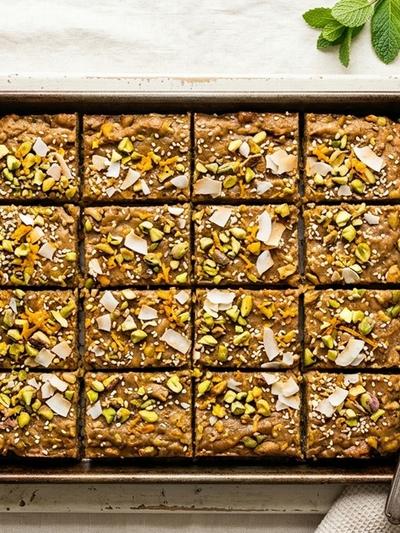
Tahini is the flavor anchor: nutty, deeply savory, and unmistakably Mediterranean. Swirled through the custard and marbled across the top, it plays against the caramel sweetness of Medjool dates and a warm backdrop of cinnamon, cardamom, and bright orange zest. Toasted sesame seeds add a light crunch to each bite, and the Greek yogurt base lends a subtle tang that keeps everything from tipping too sweet.
For GLP-1 users, these bars solve a real problem: satisfying a dessert craving without the heavy, greasy dishes that can trigger nausea or discomfort. Each bar is dense enough that a small portion feels genuinely complete, and the protein-to-calorie ratio means you are not burning through your daily budget on empty sweetness. They slice cleanly from the pan, travel well, and taste even better cold from the fridge the next day.
Why This Works on GLP-1
Twenty-five grams of protein per serving comes primarily from six whole eggs and four egg whites, supplemented by a generous cup and a half of nonfat Greek yogurt. That combination delivers all nine essential amino acids in a highly bioavailable form — important when calorie intake drops on medications like Mounjaro or Wegovy and every gram of protein counts toward preserving lean muscle mass. Research consistently shows that distributing protein across meals and snacks, rather than concentrating it at dinner, improves muscle protein synthesis throughout the day. A high-protein dessert like this one fills a gap that most sweet recipes ignore entirely.
Tahini and Medjool dates contribute modest fiber alongside healthy monounsaturated fats that work with the slowed gastric emptying your GLP-1 medication already produces. The custard's soft, smooth texture means almost no mechanical effort for your stomach, reducing the bloating and discomfort that tough or heavily fibrous desserts can cause during early treatment weeks.
The blend of protein, healthy fats, and natural sugars from dates and honey creates a measured glycemic response rather than a sharp spike and crash. No refined sugar, no artificial sweeteners, no inflammatory oils — just whole-food ingredients providing steady energy and real satisfaction from a modest portion.
Ingredients (serves )
For the custard:
- 6 large eggs
- 4 large egg whites (½ cup / 120ml liquid egg whites)
- 1½ cups (368g) nonfat plain Greek yogurt
- 2 tablespoons (30g) tahini, well stirred
- 2 tablespoons (42g) honey
- ¼ cup (20g) oat flour
- 1 teaspoon vanilla extract
- 1 teaspoon finely grated orange zest
- ½ teaspoon ground cinnamon
- ¼ teaspoon ground cardamom
- ⅛ teaspoon fine sea salt
For the topping:
- 3 Medjool dates, pitted and finely diced (about ¼ cup / 72g)
- 1 tablespoon (15g) tahini
- 1 tablespoon (9g) white sesame seeds
Instructions
Amounts in the method are for 4 servings.
Prepare the pan and preheat:
- Preheat your oven to 325°F (165°C). Line a 9×13-inch (23×33cm) baking pan with parchment paper, leaving a 2-inch overhang on the long sides for easy lifting later. Lightly mist the parchment with nonstick cooking spray. The low oven temperature bakes the custard gently so the egg proteins set gradually without curdling or cracking — rushing at higher heat produces a rubbery texture.
Mix the custard base:
In a large bowl, whisk the whole eggs and egg whites vigorously for about 1 minute until uniformly frothy and slightly lightened in color. This step incorporates air that keeps the finished bars tender rather than dense and heavy.
Add the Greek yogurt, 2 tablespoons tahini, honey, oat flour, vanilla, orange zest, cinnamon, cardamom, and salt. Whisk until the batter is completely smooth and no streaks of yogurt remain. The oat flour dissolves into the liquid — it acts as a subtle binder that helps the bars hold their shape when sliced without adding a floury taste.
Assemble and bake:
Pour the batter into the prepared pan and tap it firmly against the counter twice to release any large air bubbles. Scatter the diced dates evenly across the surface — they will sink partially into the custard as it bakes, creating pockets of caramel sweetness throughout each bar.
Stir the remaining 1 tablespoon of tahini with a few drops of warm water until it flows easily off a spoon. Drizzle it across the surface in thin zigzag lines, then drag a toothpick or skewer through the lines perpendicular to their direction to create a marbled swirl pattern. Sprinkle the sesame seeds evenly over the top.
Bake for 28–32 minutes, until the edges are firmly set and the center still has a gentle jiggle when you tap the side of the pan. A toothpick inserted near the center should come out clean or with just a thin film of custard, not wet batter. The center will firm as it cools — overbaking at this stage dries out the protein and produces a spongy texture rather than a silky one.
Cool and slice:
- Let the bars cool in the pan on a wire rack for 20 minutes, then refrigerate uncovered for at least 1 hour until fully chilled and firm throughout. Cold custard slices far more cleanly than warm. Use the parchment overhang to lift the slab onto a cutting board and cut into 8 equal bars. Each serving is 2 bars.
Nutrition per Serving
| Nutrient | Amount (approx.) |
|---|---|
| Calories | ~355 kcal |
| Protein | ~25g |
| Fat | ~15g |
| Carbohydrates | ~32g |
| Fiber | ~3g |
Calculated from USDA data for whole eggs, liquid egg whites, nonfat Greek yogurt, tahini, oat flour, Medjool dates, honey, and sesame seeds. One serving equals 2 bars.
Practical Notes
Chill before you slice. These bars rely on the egg-yogurt custard setting fully during cooling. Cutting them warm produces ragged, crumbly pieces that fall apart on the way to the plate. A minimum of one hour in the fridge gives you clean, bakery-worthy slices — overnight is even better, and the flavor deepens as the tahini mellows.
Make ahead for the entire week. Store the bars in a single layer in an airtight container in the refrigerator for up to 5 days. They actually improve overnight as the date pockets soften further into the surrounding custard. Pull a bar out 5 minutes before eating if you prefer the texture slightly less cold.
Swap the dates for dried figs. If Medjool dates are unavailable or too sweet for your palate, use the same weight of dried Turkish figs, finely chopped. Figs bring a milder, honey-like sweetness and slightly more fiber per gram, pairing just as naturally with tahini and sesame.
Portion down for smaller appetites. Cut the slab into 12 pieces instead of 8 for smaller servings during the first weeks of GLP-1 treatment, when even a modest dessert can feel like a lot. Each mini bar still delivers about 17 grams of protein — more than most conventional snack bars — and keeps you well under 250 calories.
Freeze for longer storage. Wrap each bar individually in plastic wrap, then store in a freezer bag for up to 2 months. Thaw overnight in the refrigerator. The texture holds remarkably well because the custard is dense and relatively low in free water, so it does not develop the icy, grainy quality that lighter desserts sometimes pick up in the freezer.
Frequently Asked Questions
Can I eat these bars during my first month on Ozempic or another GLP-1 medication?
Can I substitute regular yogurt for Greek yogurt?
How should I store these, and can I eat them warm?
What if I find the full serving too large on my current GLP-1 dose?
Why does the recipe use such a low oven temperature?
This article provides general food and nutrition guidance only. It does not constitute medical advice. Always consult your healthcare provider regarding your GLP-1 medication and individual nutritional needs.