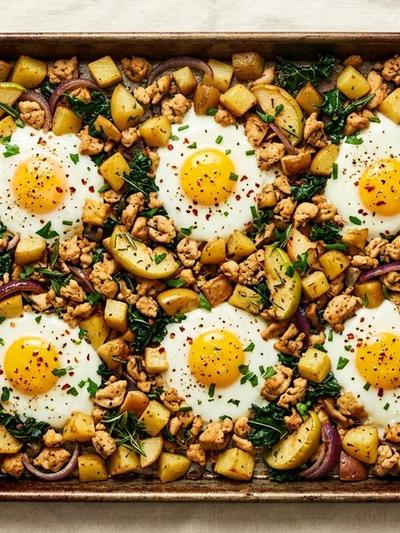
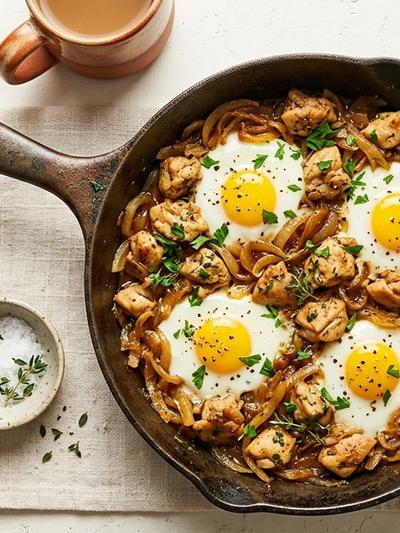
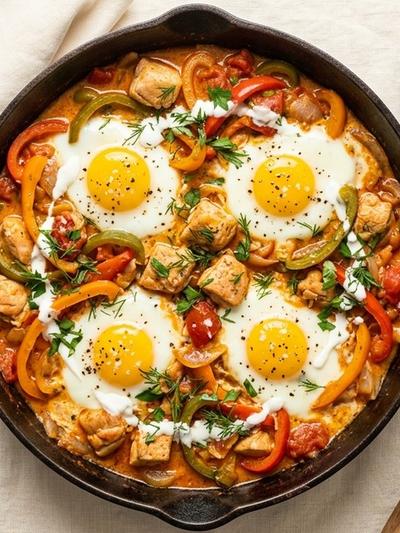
With 41 grams of protein and under 400 calories per serving, this British-inspired sheet pan breakfast delivers serious nutritional density in a manageable portion. Lean chicken breast provides the bulk of the protein, while parsnips contribute slow-digesting complex carbohydrates and nearly 5 grams of fiber per serving. A single baked egg crowns each portion, adding another 6 grams of complete protein along with choline and B vitamins that support energy metabolism throughout the morning.
The flavor here borrows from the British breakfast tradition without the heaviness. Fresh sage — the herb most associated with English breakfast sausage — coats the chicken cubes and perfumes the roasting pan. Parsnips turn golden and sweet at high heat, their natural sugars caramelizing against the edges of the pan. Leeks soften into silky ribbons, cherry tomatoes burst into jammy pockets of acidity, and a slick of Dijon mustard ties the whole tray together with gentle warmth. The result tastes far richer than its lean ingredient list suggests.
For GLP-1 users, this format solves a common breakfast dilemma: wanting something substantial enough to anchor the morning without overwhelming a reduced appetite. The protein-to-volume ratio is high, meaning a smaller plate still registers as a real meal. And because everything roasts together with minimal added fat, there is nothing here that taxes digestion or sits heavy in a slower-emptying stomach.
Why This Works on GLP-1
Each serving delivers 41 grams of protein primarily from chicken breast and egg, two of the most bioavailable protein sources available. That matters because GLP-1 medications like Wegovy and Mounjaro create a caloric deficit that, without adequate protein, can lead to muscle loss alongside fat loss. Research consistently shows that distributing protein across meals — aiming for at least 25 to 30 grams at breakfast — helps preserve lean mass during active weight loss. This recipe clears that threshold comfortably.
The parsnips provide a gentler carbohydrate source than potatoes, with a lower glycemic index and more soluble fiber per gram. Soluble fiber slows glucose absorption, which complements the blood sugar regulation already happening from your GLP-1 medication. Leeks add prebiotic fiber that supports gut bacteria, an important consideration since GLP-1 drugs alter gut motility and can disrupt the microbiome over time.
The dish is also deliberately moderate in fat at 14 grams per serving, with most of that coming from the egg yolk and a small amount of olive oil. High-fat breakfasts can worsen the nausea and early satiety that many GLP-1 users experience, particularly in the first months of treatment. This recipe stays well below the threshold where fat becomes problematic while still tasting satisfying and complete.
Ingredients (serves 2)
For the hash:
- 10 oz (280g) boneless, skinless chicken breast, cut into 3/4-inch (2cm) cubes
- 2 small parsnips (180g total), peeled and diced into 1/2-inch (1.5cm) cubes
- 1 large leek (120g usable), white and light green parts, halved lengthwise and sliced into 1/2-inch (1.5cm) half-moons
- 6 oz (170g) cherry tomatoes, halved
- 2 teaspoons (10ml) extra-virgin olive oil
- 1 tablespoon (15g) Dijon mustard
- 1 tablespoon fresh sage, finely chopped (about 8 leaves)
- 1 teaspoon fresh thyme leaves
- 1/2 teaspoon garlic powder
- 1/4 teaspoon fine sea salt
- 1/4 teaspoon freshly ground black pepper
For the baked eggs and finishing:
- 2 large eggs
- Pinch of flaky sea salt
- 1 tablespoon fresh chives, finely snipped
- Fresh thyme sprigs for garnish
Instructions
Prepare the vegetables and chicken:
Preheat your oven to 425°F (220°C) and line a large rimmed sheet pan with parchment paper. The high heat is essential for caramelizing the parsnips quickly rather than steaming them, which gives the hash its signature sweetness and crisp edges.
Rinse the halved leek slices in a bowl of cold water, agitating gently to release any grit trapped between the layers. Lift them out and pat dry with a clean towel. Leeks hold soil between their rings, and skipping this step means gritty breakfast.
In a large mixing bowl, whisk together the olive oil, Dijon mustard, garlic powder, salt, and pepper until smooth. Add the cubed chicken breast, diced parsnips, and leek slices. Toss until everything is evenly coated. The mustard acts as both a flavor agent and an emulsifier, helping the small amount of oil cling to every surface for better browning.
Fold in the chopped sage and thyme leaves and toss once more.
Roast the hash:
Spread the chicken and vegetable mixture in a single layer across the prepared sheet pan. Avoid crowding — if pieces overlap, they steam instead of roasting. The pan should look fairly spacious with small gaps between the pieces.
Roast for 15 minutes on the middle rack. The parsnips should be turning golden at the edges and the chicken should be nearly cooked through with light browning on the top surfaces.
Add the tomatoes and eggs:
Remove the pan from the oven. Scatter the halved cherry tomatoes across the hash. Using the back of a spoon, press two shallow wells into the mixture, spacing them apart so each well has a border of hash around it. The wells do not need to be deep — just enough of a depression to cradle an egg.
Crack one egg into each well. Season the eggs with a small pinch of flaky sea salt.
Return the pan to the oven and roast for 8 to 10 minutes. Check at the 8-minute mark: the egg whites should be fully set and opaque while the yolks remain slightly soft and jammy. If you prefer fully set yolks, leave them for the full 10 minutes.
Finish and serve:
- Remove the pan from the oven and let it rest on a heatproof surface for 2 minutes. The eggs will continue to set slightly from residual heat. Scatter the snipped chives and a few fresh thyme sprigs over the top. Serve directly from the pan or use a spatula to portion each egg with its surrounding hash onto warmed plates.
Nutrition per Serving
| Nutrient | Amount (approx.) |
|---|---|
| Calories | ~392 kcal |
| Protein | ~41g |
| Fat | ~14g |
| Carbohydrates | ~27g |
| Fiber | ~6g |
Estimates based on USDA values for raw chicken breast, parsnips, leeks, cherry tomatoes, large eggs, olive oil, and Dijon mustard. Actual values may vary with ingredient brands and exact sizes.
Practical Notes
Make it ahead for weekday mornings. Roast the hash (chicken, parsnips, leeks, tomatoes) through step 6 on Sunday, then refrigerate in an airtight container for up to three days. When ready to eat, spread the cold hash on a sheet pan, reheat at 400°F (200°C) for 8 minutes, then add the egg wells and bake for another 8 to 10 minutes. This turns a 40-minute recipe into a 20-minute weekday breakfast.
Scale to four servings without changing the method. Double all ingredients and use two sheet pans on separate oven racks, rotating them halfway through the initial 15-minute roast. The egg step works the same way — two wells per pan. This is the most efficient way to meal prep breakfast for a partner or for several days ahead.
Swap parsnips if they are hard to find. Turnips or carrots cut to the same size work well. Turnips give a slightly peppery edge that pairs with sage, while carrots lean sweeter. Avoid butternut squash, which releases too much moisture and makes the pan soggy. Whatever root vegetable you choose, keep the dice small so it cooks through in 15 minutes at high heat.
Eat slowly and stop when satisfied. GLP-1 medications make it physically easier to stop eating before the plate is empty — work with that signal rather than against it. If one serving feels like too much food in the early weeks of treatment, plate half a portion and refrigerate the rest. Cold hash reheats beautifully in a dry skillet over medium heat for 4 to 5 minutes.
Add a small side if you need more volume. A handful of baby spinach wilted on the hot hash after it comes out of the oven adds bulk and iron without meaningful calories. Or serve alongside a thin slice of whole grain toast to bring the carbohydrates up for mornings when you have more appetite and need sustained energy for exercise or a long shift.
Frequently Asked Questions
Can I use chicken thighs instead of breast for more flavor?
Is this too heavy for mornings when my appetite is very low on GLP-1?
How should I store and reheat leftovers?
I experience nausea in the morning on my GLP-1 medication. Will this recipe trigger it?
Why does the recipe call for Dijon mustard rather than English mustard?
This article provides general food and nutrition guidance only. It does not constitute medical advice. Always consult your healthcare provider regarding your GLP-1 medication and individual nutritional needs.