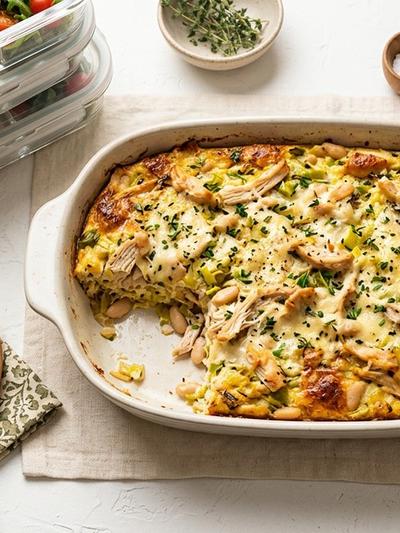
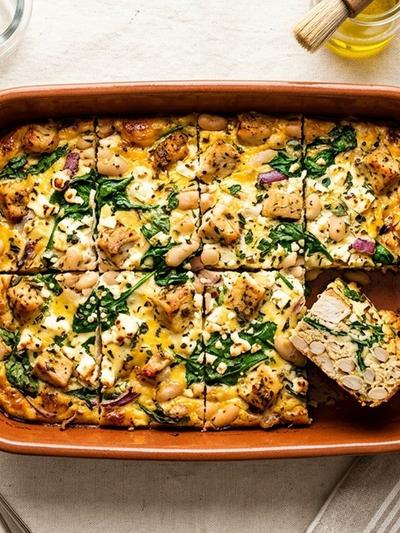
Each serving of this Nordic-inspired egg bake delivers roughly 38 grams of protein from three complementary sources — chicken breast, whole eggs, and cottage cheese. That protein density makes it one of the most efficient batch breakfasts you can prepare, requiring about 15 minutes of hands-on work for four days of ready-to-eat morning meals. The combination of lean chicken and low-fat cottage cheese keeps the calorie count under 325 per generous slice while providing all essential amino acids.
The flavor profile draws from Scandinavian breakfast traditions: generous fresh dill, a spoonful of whole grain mustard, and sweet caramelized onions give this bake a savory depth that feels distinctly Northern European. Cottage cheese melts into the egg custard during baking, creating a texture that lands somewhere between a frittata and a savory bread pudding — tender, slightly creamy, and satisfying without being heavy. A scattering of dark rye breadcrumbs across the top adds a toasty, nutty crunch that contrasts with the soft interior.
For anyone on GLP-1 medication, this format solves the morning appetite problem elegantly. A single pre-cut square reheats in two minutes and provides substantial protein without requiring you to cook when your appetite is at its lowest. The soft, custard-like texture is gentle on a slower digestive system, and the portion size is satisfying without being overwhelming.
Why This Works on GLP-1
Muscle preservation is one of the most important nutritional priorities during GLP-1-assisted weight loss. When medications like Mounjaro or Wegovy reduce your calorie intake significantly, your body can break down muscle tissue for energy unless you consistently hit adequate protein targets. At 38 grams per serving, this egg bake covers roughly 40–50% of most people's daily protein needs in a single breakfast, setting a strong foundation for the rest of the day. The triple protein source — chicken, eggs, and cottage cheese — provides a complete amino acid profile with high bioavailability.
The cottage cheese base adds casein protein, which digests more slowly than whey or egg protein. This slower absorption works in your favor on GLP-1 medications, providing a steady stream of amino acids rather than a rapid spike. The result is sustained satiety that aligns well with the appetite-suppressing effects of your medication.
Whole eggs contribute choline, a nutrient that supports liver function during periods of fat metabolism — particularly relevant during active weight loss. The modest fat content from eggs also aids absorption of fat-soluble vitamins without pushing the overall calorie count into uncomfortable territory for smaller GLP-1 appetites.
Ingredients (serves 4)
For the egg bake:
- 12 oz (340g) boneless, skinless chicken breast, cut into small 1/2-inch dice
- 6 large eggs
- 1 1/2 cups (340g) low-fat cottage cheese (2%)
- 1 medium yellow onion, finely diced — about 1 cup (150g)
- 3 cups (90g) baby spinach, roughly chopped
- 3 tablespoons fresh dill, finely chopped (plus extra for garnish)
- 1 tablespoon whole grain mustard
- 1/2 teaspoon fine sea salt
- 1/4 teaspoon freshly ground black pepper
- 1/4 teaspoon ground nutmeg
- 1 teaspoon olive oil or cooking spray
For the rye crumb topping:
- 1 slice dark rye bread (about 1 oz / 30g), pulsed into coarse crumbs
- 1 teaspoon olive oil
- Pinch of flaky sea salt
Instructions
Prepare the chicken and vegetables:
Preheat your oven to 375°F (190°C). Lightly grease a 9×9-inch (23×23 cm) or 8×10-inch baking dish with cooking spray or a thin film of olive oil.
Heat 1 teaspoon of olive oil in a large nonstick skillet over medium heat. Add the diced onion and cook for 5–6 minutes, stirring occasionally, until softened and just beginning to turn golden. The slow caramelization develops a natural sweetness that balances the mustard and dill.
Add the diced chicken breast to the skillet and cook for 3–4 minutes, stirring frequently, until the pieces are white on the outside but not fully cooked through — they will finish cooking in the oven. Season lightly with a pinch of salt.
Add the chopped spinach to the skillet and stir for about 30 seconds, just until it begins to wilt. Remove the skillet from heat and let the mixture cool for 2–3 minutes.
Assemble the egg bake:
In a large mixing bowl, whisk the eggs until smooth. Add the cottage cheese, chopped dill, whole grain mustard, salt, pepper, and nutmeg. Whisk until well combined — small curds of cottage cheese remaining is perfectly fine, as they will melt and create pockets of creaminess.
Fold the slightly cooled chicken and vegetable mixture into the egg-cottage cheese base. Stir gently to distribute everything evenly.
Pour the mixture into the prepared baking dish, spreading it into an even layer with a spatula.
Add the rye crumb topping and bake:
Toss the rye breadcrumbs with 1 teaspoon of olive oil and a pinch of flaky salt. Scatter evenly over the surface of the egg bake. The crumbs will toast during baking, creating a crunchy contrast to the soft custard beneath.
Bake for 28–32 minutes, until the center is set and no longer jiggles when you gently shake the dish. A knife inserted in the center should come out clean. The top should be lightly golden and the rye crumbs visibly toasted.
Let the bake rest in the dish for 10 minutes before slicing. This resting period allows the custard to firm up, making it much easier to cut clean portions. Slice into 4 equal squares. Garnish with extra fresh dill if serving immediately.
Nutrition per Serving
| Nutrient | Amount (approx.) |
|---|---|
| Calories | ~322 kcal |
| Protein | ~38g |
| Fat | ~13g |
| Carbohydrates | ~12g |
| Fiber | ~2g |
Estimates based on low-fat cottage cheese, large eggs, raw chicken breast, and dark rye bread. Actual values may vary slightly depending on specific brands and exact portions.
Practical Notes
Meal prep storage and reheating. Once cooled completely, wrap each square individually in plastic wrap or place in separate airtight containers. Refrigerate for up to 5 days. Reheat a single portion in the microwave for 90 seconds at medium power, or warm in a 350°F (175°C) oven for 8–10 minutes. The rye crumbs will soften slightly in the fridge but regain some texture with oven reheating.
Freezer-friendly option. This bake freezes well for up to 6 weeks. Wrap individual portions tightly in plastic wrap, then aluminum foil, and place in a freezer bag. Thaw overnight in the refrigerator and reheat as above. Having frozen portions on hand means you always have a high-protein breakfast ready, even on days when cooking feels like too much effort.
Cottage cheese substitution. If you prefer a different texture, ricotta works as a direct swap but adds slightly more fat and less protein. For a higher protein option, use skyr blended until smooth — it adds a mild tanginess that pairs beautifully with the dill and mustard. Avoid fat-free cottage cheese, which can make the bake rubbery.
Scaling for the week. To make 5 portions, increase to a 9×13-inch dish and scale all ingredients by 1.25×. This is particularly useful if you eat breakfast every day and want no gaps in your weekly prep. The larger batch bakes at the same temperature but may need 3–5 additional minutes.
Pair with a simple side for extra volume. If your appetite allows, serve alongside a few cherry tomatoes and a slice of crispbread. On days when Zepbound or similar medications suppress your appetite heavily, the egg bake square alone provides substantial nutrition in a compact, manageable portion.
Frequently Asked Questions
Can I eat this cold if my GLP-1 medication makes mornings difficult?
Can I make this dairy-free?
How long do the individual portions last in the refrigerator?
What if I can only eat half a portion in the early weeks of GLP-1 treatment?
Can I add other vegetables to the bake?
This article provides general food and nutrition guidance only. It does not constitute medical advice. Always consult your healthcare provider regarding your GLP-1 medication and individual nutritional needs.