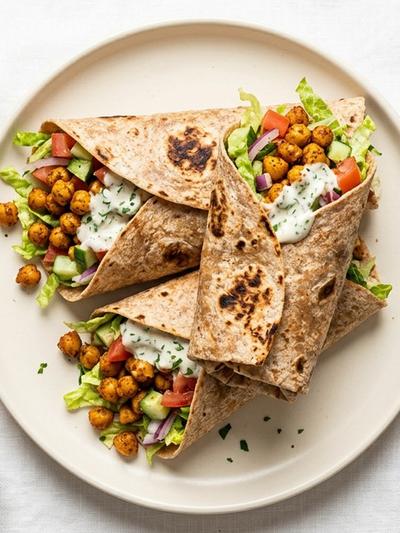
Each of these Greek-inspired wraps delivers 30 grams of protein from a combination of thick nonfat Greek yogurt and tender chickpeas, along with 8 grams of fiber to support steady digestion. The yogurt isn't just a condiment here — a generous herbed layer forms the creamy, protein-dense backbone of the entire wrap. With only 388 calories per serving, you get a complete, macro-balanced lunch that keeps you satisfied without heaviness.
The flavor profile borrows from classic Greek taverna cooking: warm oregano and garlic meet bright lemon zest, while quick-charred zucchini and sweet red pepper bring smoky depth to the filling. A scattering of crumbled feta adds salt and tang that plays against the cool, dill-flecked yogurt spread. The contrast between the hot, just-wilted stir-fry and the chilled herbed yogurt gives every bite both temperature and textural interest.
For anyone on Ozempic or Mounjaro, wraps solve a common problem — they look and feel like a full meal even when portions are smaller. The whole wheat tortilla holds everything together in a tidy package, so you can eat half now and save the rest without the filling falling apart. The stir-fry step takes just six minutes, making this one of the fastest high-protein lunches you can assemble.
Why This Works on GLP-1
Each wrap provides 30 grams of protein, primarily from nonfat Greek yogurt and chickpeas — two sources that digest at different rates, extending satiety beyond what either would achieve alone. During GLP-1-assisted weight loss, preserving lean muscle mass depends on consistent protein intake at every meal. Hitting 30 grams at lunch helps meet the 100–120 gram daily target that many dietitians recommend for patients on Wegovy or Zepbound. The dairy-based protein in Greek yogurt also supplies leucine, an amino acid especially important for muscle protein synthesis.
The 8 grams of fiber per serving come from chickpeas, whole wheat tortilla, and the vegetable filling — a moderate amount that supports regularity without overwhelming a slower-moving digestive system. GLP-1 medications delay gastric emptying, so gentle, well-distributed fiber tends to be better tolerated than large doses from raw cruciferous vegetables or bran. The zucchini is particularly easy on digestion, providing bulk and moisture with very little fermentable fiber.
Greek yogurt brings a meaningful dose of calcium and probiotics, both of which can be compromised during extended calorie restriction. The B vitamins in chickpeas support energy metabolism, and the lemon juice improves iron absorption from the plant-based protein sources. These micronutrient details matter most during the sustained caloric deficits that GLP-1 treatment often produces.
Ingredients (serves 2)
For the herbed yogurt spread:
- 1 cup (230g) nonfat plain Greek yogurt
- 2 tablespoons fresh dill, finely chopped
- 1 small clove garlic, minced or grated
- 1 teaspoon lemon zest
- 1 tablespoon fresh lemon juice
- Pinch of salt and black pepper
For the stir-fry filling:
- 1 medium zucchini (about 200g), halved lengthwise and sliced into half-moons
- 1 small red bell pepper (about 120g), cut into thin strips
- ½ cup (85g) canned chickpeas, drained and rinsed
- ½ cup (75g) cherry tomatoes, halved
- ¼ small red onion (about 30g), thinly sliced
- 2 teaspoons olive oil
- 1 teaspoon dried oregano
- ½ teaspoon ground cumin
- 1 clove garlic, minced
- Salt and black pepper to taste
For assembly:
- 2 whole wheat tortillas (8-inch / 20cm)
- 1 ounce (30g) crumbled feta cheese
- Fresh mint leaves, for garnish
- Lemon wedges, for serving
Instructions
Make the herbed yogurt spread:
- Combine the Greek yogurt, dill, garlic, lemon zest, lemon juice, salt, and pepper in a small bowl. Stir well and set aside. Making this first allows the flavors to meld while you cook the filling — even five minutes makes a noticeable difference in how the garlic and dill integrate.
Stir-fry the filling:
Heat the olive oil in a large nonstick skillet or wok over medium-high heat until it just begins to shimmer. A properly heated pan is essential here — too cool and the zucchini will steam and turn mushy instead of picking up golden edges.
Add the zucchini half-moons in a single layer and cook undisturbed for 2 minutes until the undersides are golden. Flip and cook 1 minute more, then push them to the edges of the pan.
Add the red bell pepper and red onion to the center of the pan. Stir-fry for 2 minutes until the pepper softens slightly but still has some snap. The onion should turn translucent at the edges.
Add the chickpeas, cherry tomatoes, garlic, oregano, and cumin. Toss everything together and cook for 90 seconds, just until the tomatoes begin to collapse and the spices become fragrant. Season with salt and pepper. Remove from heat immediately — carryover heat will continue softening the vegetables.
Assemble the wraps:
Warm each tortilla briefly in a dry skillet or microwave for 15 seconds. This makes them pliable enough to roll without cracking.
Spread half of the herbed yogurt down the center of each tortilla, creating a thick stripe rather than a thin smear — this is your primary protein layer, so be generous.
Spoon the warm stir-fry filling over the yogurt. Top with crumbled feta and a few fresh mint leaves.
Fold the bottom edge of the tortilla up over the filling, tuck in the sides, and roll tightly. Slice in half on a diagonal for easier handling. Serve immediately with lemon wedges.
Nutrition per Serving
| Nutrient | Amount (approx.) |
|---|---|
| Calories | ~388 kcal |
| Protein | ~30g |
| Fat | ~9g |
| Carbohydrates | ~44g |
| Fiber | ~8g |
Estimates based on nonfat Greek yogurt (e.g., Fage 0%), standard canned chickpeas, 8-inch whole wheat tortillas (~120 kcal each), and 15g feta per serving.
Practical Notes
The yogurt spread doubles as a dip for leftovers. Make a double batch of the herbed yogurt and store the extra in an airtight container for up to four days. It works as a dip for raw vegetables, a sauce for grilled chicken, or a protein-boosting spread on toast — each quarter-cup adds roughly 8 grams of protein to whatever you pair it with.
You can prep the components separately for next-day assembly. Store the cooked stir-fry filling and the herbed yogurt in separate containers in the fridge. Assemble wraps fresh when ready to eat — this prevents the tortilla from getting soggy. The filling keeps well for three days refrigerated.
Swap the tortilla for lettuce wraps to cut calories further. Two large butter lettuce leaves per wrap reduces the total to about 270 calories while keeping all 30 grams of protein intact. This is a good option during the first weeks of Zepbound or Mounjaro treatment when appetite is especially suppressed and even a small tortilla feels like too much.
Don't skip the cumin in the chickpeas. It does more than add flavor — cumin has carminative properties that can help reduce the gas and bloating that chickpeas sometimes cause. For GLP-1 users already dealing with slower digestion, this small addition makes a real difference in comfort after eating.
Eat half now, wrap half for later. If a full wrap feels like too much food, eat one half and wrap the other tightly in foil. It holds well at room temperature for up to two hours or refrigerated for the next day. This half-portion approach gives you roughly 15 grams of protein per sitting — enough to be meaningful without pushing past your comfortable limit.
Frequently Asked Questions
I feel nauseous after eating wraps on GLP-1 medication — will this recipe be different?
Can I use full-fat Greek yogurt instead of nonfat?
How should I store and reheat these wraps?
What if I can only eat very small portions in the early weeks of GLP-1 treatment?
The chickpeas in the stir-fry seem unusual — why not just add them cold?
This article provides general food and nutrition guidance only. It does not constitute medical advice. Always consult your healthcare provider regarding your GLP-1 medication and individual nutritional needs.