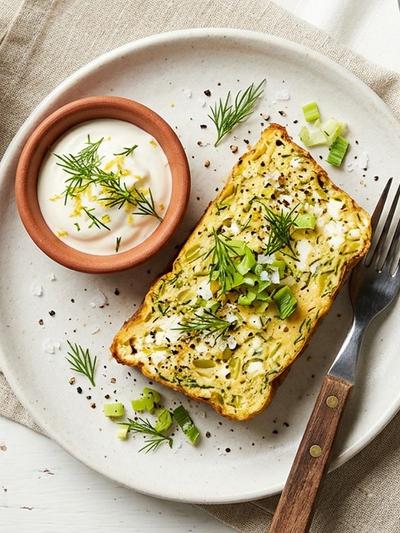
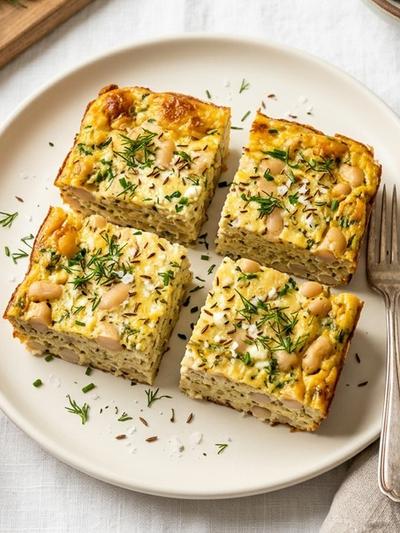
Each serving of these Alsatian-inspired custard cups delivers 27 grams of protein from a combination of whole eggs, egg whites, and blended cottage cheese, all for just 249 calories. The leek and Gruyère base provides calcium and B vitamins alongside the protein, making this a nutritionally dense snack that punches well above its modest portion size. Cottage cheese blended smooth into the custard base adds body and protein without the heaviness of cream, keeping fat to 12 grams per serving.
The flavor here is unmistakably Alsatian — sweet caramelized leeks paired with the warm earthiness of freshly grated nutmeg and the sharp, slightly nutty bite of real Gruyère. A touch of Dijon mustard works in the background, adding depth the way it does in a good quiche Lorraine without ever becoming sharp or overpowering. The slow cooker's gentle, even heat produces a texture somewhere between a firm flan and a soft frittata: silky through the center, just set enough to hold its shape when unmolded.
These custard cups are ideally suited to GLP-1 eating because they are rich, satisfying, and small. Two cups make a complete snack that sits comfortably in a reduced-appetite stomach without the density of bread or pastry. The soft, custard-like texture is easy to digest even on days when heavier foods feel like too much, and they taste just as good cold from the fridge as they do warm from the cooker — true grab-and-go convenience.
Why This Works on GLP-1
The 27 grams of protein per serving comes from three complementary sources: whole eggs contribute complete amino acids along with choline and vitamin D, egg whites add pure lean protein, and cottage cheese rounds out the total while keeping the fat profile moderate. Maintaining adequate protein intake is one of the most important nutritional priorities during GLP-1-assisted weight loss with medications like Wegovy or Mounjaro, because the appetite reduction that makes these drugs effective also makes it easy to undereat protein. Muscle preservation depends on consistent protein distribution across meals and snacks throughout the day, and a 27-gram snack meaningfully contributes to the 100–130 gram daily target most active adults need during a caloric deficit.
The custard texture is a practical advantage for digestion. Slow-cooked eggs set gently rather than toughening, which makes them easier for a GLP-1-slowed stomach to process compared to fried or scrambled eggs. Leeks provide a small amount of prebiotic fiber that supports gut bacteria without the gas and bloating that high-fiber vegetables like raw broccoli or cabbage can cause.
At 249 calories per serving, these custard cups leave room in a daily budget that may already be compressed by reduced appetite. The fat content is moderate enough to avoid the heaviness that high-fat snacks can create when gastric emptying is delayed, while still providing enough richness to feel genuinely satisfying rather than diet-like.
Ingredients (serves 4)
For the leek base:
- 1 teaspoon olive oil
- 1 large leek, white and light green parts only, halved lengthwise and thinly sliced (about 1 cup / 90g)
- 1 clove garlic, minced
- Pinch of fine sea salt
For the custard:
- 6 large eggs
- 6 large egg whites (or ¾ cup / 180ml liquid egg whites)
- 1½ cups (340g) low-fat cottage cheese (2%)
- 1 oz (28g) Gruyère cheese, finely grated
- 1 teaspoon Dijon mustard
- ¼ teaspoon ground nutmeg
- ½ teaspoon fine sea salt
- ¼ teaspoon white pepper
For finishing:
- 2 tablespoons fresh chives, finely chopped
- 1 tablespoon fresh thyme leaves (or 1 teaspoon dried thyme)
Instructions
Prepare the leeks:
- Heat the olive oil in a small skillet over medium heat. Add the sliced leeks and the pinch of salt, then cook for 4–5 minutes, stirring occasionally, until softened and just beginning to turn golden. The salt draws out moisture and helps the leeks caramelize rather than steam.
- Add the garlic and cook for 30 seconds until fragrant. Remove from heat and set aside to cool slightly.
Make the custard base:
- Put the cottage cheese into a blender or food processor and blend for 30–45 seconds until completely smooth with no visible curds. This step is essential — unblended cottage cheese creates a grainy custard, while blended cottage cheese mimics the silkiness of heavy cream with a fraction of the fat.
- In a large bowl, whisk together the whole eggs and egg whites until uniformly combined. Add the blended cottage cheese, grated Gruyère, Dijon mustard, nutmeg, salt, and white pepper. Whisk until the mixture is smooth and homogeneous.
- Fold in the cooled leeks, chopped chives, and thyme leaves. Stir gently to distribute the leeks evenly throughout the custard.
Fill the ramekins:
- Lightly coat eight 4-ounce (120ml) ramekins or half-pint Mason jars with cooking spray. Divide the custard mixture evenly among them — each should be about three-quarters full. If using Mason jars, do not screw the lids on; cover each loosely with a small square of aluminum foil to prevent condensation from dripping onto the surface.
- Place a folded kitchen towel or silicone trivet in the bottom of your slow cooker to prevent the ramekins from sitting directly on the heating element. Arrange the ramekins in a single layer on top. If your slow cooker can only fit four at a time, cook in two batches.
- Carefully pour warm water into the slow cooker around the ramekins until it reaches about halfway up their sides. This water bath ensures the custard cooks evenly and gently, preventing the edges from overcooking before the center sets.
Cook:
- Cover and cook on Low for 1 hour 45 minutes to 2 hours. The custard cups are done when the edges are firmly set and the center has only a very slight jiggle when you tap the ramekin — it will continue to firm up as it cools. Avoid cooking past 2 hours, as overcooked egg custard develops a rubbery texture and may weep liquid.
- Using tongs or a jar lifter, carefully remove the ramekins from the slow cooker. Let them cool on a wire rack for 15 minutes before serving warm, or refrigerate uncovered for at least 1 hour before covering and storing.
Nutrition per Serving
| Nutrient | Amount (approx.) |
|---|---|
| Calories | ~249 kcal |
| Protein | ~27g |
| Fat | ~12g |
| Carbohydrates | ~7g |
| Fiber | ~1g |
Calculated based on 2% low-fat cottage cheese, large eggs, and Gruyère. Values may vary slightly by brand.
Practical Notes
Batch prep and storage. These custard cups keep in the refrigerator for up to 4 days, covered with plastic wrap or foil. They are excellent cold — the flavors actually concentrate overnight as the nutmeg and Gruyère meld into the custard. Pull one out of the fridge for a quick protein-rich snack without any reheating needed.
Reheating without ruining the texture. If you prefer them warm, microwave a single cup at 50% power for 30–40 seconds. Full-power microwaving overheats the edges before the center warms through, turning the silky custard tough. Alternatively, let them sit at room temperature for 20 minutes, which brings out the flavor without any risk of overcooking.
Cheese substitutions. Gruyère is traditional in Alsatian cooking, but Comté or Emmental work equally well and melt just as smoothly into the custard. Avoid pre-shredded cheese, which is coated in anti-caking starch that can affect the custard's texture. A sharp aged Swiss is the closest substitute at most grocery stores.
Ramekin alternatives. Silicone muffin cups work if you do not have ramekins — place them directly in the slow cooker without the water bath, as silicone conducts heat more gently than ceramic. Half-pint Mason jars are the most portable option if you plan to carry these to work: just screw the lid on after cooling and toss it in your bag.
Scaling for smaller appetites. During the first weeks on a GLP-1 medication, even a single custard cup (roughly 125 calories and 13.5 grams of protein) may be the right snack size. Do not force a second cup if one feels sufficient — the goal is consistent protein intake across the day, not maximizing volume at any single sitting.
Frequently Asked Questions
Can I eat these if I'm experiencing nausea on my GLP-1 medication?
Can I make these dairy-free?
How do I know the custard is done without overcooking it?
What if my appetite is very small and I can only eat one cup at a time?
Can I use a different herb combination?
This article provides general food and nutrition guidance only. It does not constitute medical advice. Always consult your healthcare provider regarding your GLP-1 medication and individual nutritional needs.