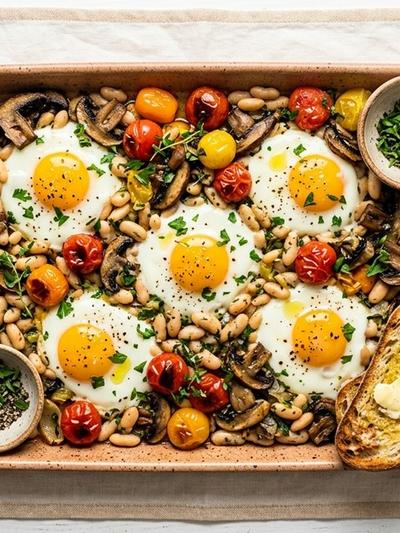
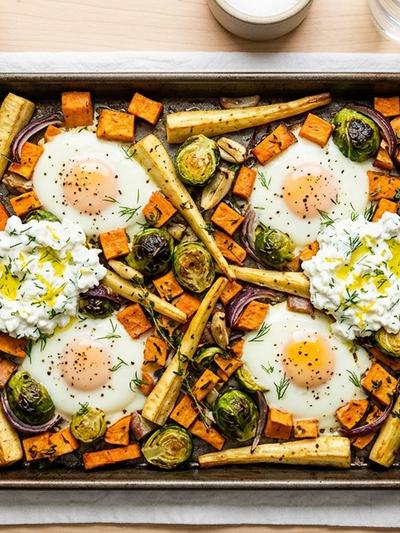
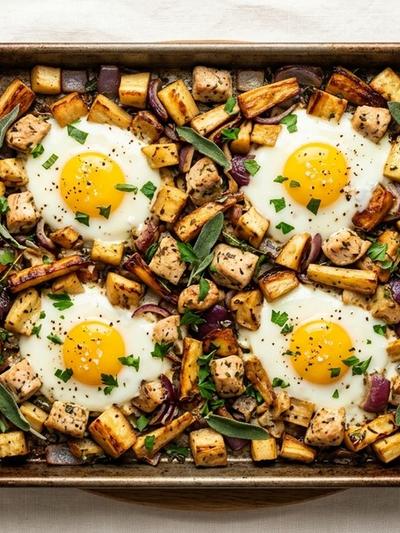
This sheet pan lunch delivers 26 grams of protein per serving from a straightforward combination of baked eggs and cannellini beans, supported by a generous bed of roasted bell peppers, tomatoes, and red onion. Each serving provides 9 grams of fiber and stays under 400 calories, making it a complete, balanced midday meal without the heaviness. Sweet Hungarian paprika and a touch of smoked paprika give the vegetables real depth, while the beans add a creamy, starchy base that makes every bite feel substantial.
The flavor here is all about caramelization meeting paprika warmth. Roasted bell peppers turn sweet and jammy at high heat, the tomatoes concentrate into something almost sauce-like, and the red onion softens into silky strips that thread through every forkful. The eggs bake directly on top of this vegetable bed, their whites setting firm while the yolks stay just runny enough to coat the beans and peppers when you cut in. It tastes like a deconstructed Hungarian lecsó, reimagined as an easy sheet pan meal.
For GLP-1 users, this recipe solves a common lunch problem: finding something satisfying that does not sit heavily in a slower-moving stomach. The vegetables roast down to a concentrated, easy-to-digest volume, and the eggs provide complete protein without the density of a large piece of meat. The entire recipe comes together on one pan with minimal hands-on work, and the portions are naturally moderate — exactly what a midday meal should look like when your appetite runs smaller.
Why This Works on GLP-1
Each serving provides 26 grams of complete protein, primarily from three whole eggs plus the complementary amino acids in cannellini beans. Maintaining adequate protein intake is essential during GLP-1-assisted weight loss to preserve lean muscle mass, and many Mounjaro users find that egg-based meals are among the easiest proteins to tolerate during periods of reduced appetite. The protein here digests at a moderate pace, supporting sustained satiety through the afternoon without the bloated feeling that denser meats can sometimes cause.
The 9 grams of fiber per serving come from the white beans and roasted vegetables — a gentle, soluble-fiber-heavy combination that supports digestive regularity without the aggressive roughage that can aggravate the slower gastric emptying common with GLP-1 medications. Cannellini beans are particularly well-tolerated because their creamy texture means less mechanical digestive work compared to higher-cellulose legumes like kidney beans.
The fat content stays moderate at 17 grams per serving, almost entirely from the egg yolks, which also supply choline, vitamin D, and B12 — nutrients that Wegovy users sometimes fall short on when overall food intake decreases. The combination of protein, fiber, and healthy fat in a single pan makes this a nutritionally efficient lunch that covers multiple bases with minimal cooking effort.
Ingredients (serves 4)
For the roasted vegetable base:
- 3 large bell peppers (red, yellow, and orange), seeded and cut into 1-inch strips
- 3 medium Roma tomatoes, quartered lengthwise
- 1 medium red onion, cut into thin wedges
- 3 cloves garlic, thinly sliced
- 1 can (15 oz / 425g) cannellini beans, drained and rinsed
- 2 teaspoons sweet Hungarian paprika
- 1/2 teaspoon smoked paprika
- 2 teaspoons olive oil
- 1/2 teaspoon fine sea salt
- 1/4 teaspoon freshly ground black pepper
For the eggs:
- 12 large eggs
- Pinch of flaky sea salt
- Pinch of smoked paprika
For serving:
- 2 tablespoons fresh flat-leaf parsley, roughly chopped
- 1 teaspoon red wine vinegar (optional)
Instructions
Prepare the sheet pan and vegetables:
Preheat your oven to 425°F (220°C) and line a large rimmed sheet pan with parchment paper. Position a rack in the center of the oven so the vegetables and eggs cook evenly from all sides.
Spread the bell pepper strips, tomato quarters, red onion wedges, and sliced garlic across the prepared pan. Scatter the drained cannellini beans over the vegetables. Drizzle with the olive oil, then sprinkle the sweet paprika, smoked paprika, salt, and black pepper over everything.
Toss the vegetables and beans directly on the pan using your hands or a spatula until everything is evenly coated in the paprika and oil. Spread into a single, even layer — the vegetables need contact with the hot pan surface to caramelize properly rather than steam.
Roast the vegetables:
Roast for 20 minutes, until the pepper edges are beginning to char and the tomatoes have collapsed and released their juices. The onion wedges should be soft and starting to brown at the tips. Stir once halfway through to ensure even cooking and to redistribute the beans, which can dry out if they sit on top the entire time.
Remove the pan from the oven and use the back of a spoon to create 12 shallow wells in the vegetable mixture — three per serving quadrant. Push the beans and vegetables aside gently to form nests where the eggs will sit. The vegetable juices pooling on the pan will help the egg whites set from below.
Bake the eggs:
Crack one egg into each of the 12 wells. Work carefully to keep the yolks intact — cracking into a small bowl first and then sliding each egg into its well gives you more control. Sprinkle each egg with a small pinch of flaky salt and smoked paprika.
Return the pan to the oven and bake for 10 to 12 minutes. At 10 minutes the whites will be just set with yolks still runny — check by gently jiggling the pan. For fully set yolks, leave them for the full 12 minutes. The eggs will continue cooking for another minute on the hot pan after you remove it, so pull them slightly before your preferred doneness.
Finish and serve:
Remove the pan from the oven and let it rest for 2 minutes. Scatter the chopped parsley over the top and drizzle with the red wine vinegar if using — the acidity cuts through the richness of the egg yolks and brightens the sweet roasted peppers.
Divide into four portions using a spatula, giving each person three eggs and a quarter of the vegetable-bean mixture. Serve directly from the pan or plate over a small piece of crusty bread if your appetite allows it.
Nutrition per Serving
| Nutrient | Amount (approx.) |
|---|---|
| Calories | ~385 kcal |
| Protein | ~26g |
| Fat | ~17g |
| Carbohydrates | ~25g |
| Fiber | ~9g |
Estimates based on 3 large eggs, approximately 80g drained cannellini beans, mixed bell peppers, Roma tomatoes, and 1/2 teaspoon olive oil per serving.
Practical Notes
This reheats better than most egg dishes. Store individual portions in airtight containers in the refrigerator for up to 3 days. Reheat in a 350°F (175°C) oven for 8 to 10 minutes — the microwave works in a pinch but can make the egg whites rubbery. The yolks will set fully during reheating, which actually works well for a packed lunch.
Scale the eggs to your appetite. If you are in an early phase of GLP-1 treatment and eating smaller volumes, reduce to two eggs per serving and increase the bean portion slightly to maintain protein. Two eggs with extra beans still delivers around 20 grams of protein, which is a reasonable lunch target when your total daily intake is lower.
Substitute peppers based on what you find. Hungarian wax peppers, banana peppers, or even cubanelles work beautifully here if you can find them — they are more traditional than bell peppers and roast to an even sweeter, silkier texture. Avoid hot peppers unless you know your stomach tolerates them well on medication.
Sweet Hungarian paprika matters. Generic paprika from a dusty jar will taste like red dust. Fresh Hungarian sweet paprika — look for brands from Szeged or Kalocsa — has a deep, sweet, almost fruity warmth that defines this dish. Smoked Spanish pimentón works as a substitute for the smoked paprika component but has a different character than Hungarian varieties.
Add a protein boost without changing the recipe. A 2-tablespoon dollop of plain Greek yogurt on each serving adds 3 grams of protein and a cool, tangy contrast to the warm paprika vegetables. This is traditional in Hungarian cooking and makes the dish feel more complete without adding significant calories.
Frequently Asked Questions
Can I eat this if my GLP-1 medication makes me sensitive to eggs?
Can I use a different type of bean?
How long does this keep, and can I freeze it?
What if I can only eat a very small portion right now?
Why do the eggs need wells in the vegetables instead of just cracking them on top?
This article provides general food and nutrition guidance only. It does not constitute medical advice. Always consult your healthcare provider regarding your GLP-1 medication and individual nutritional needs.