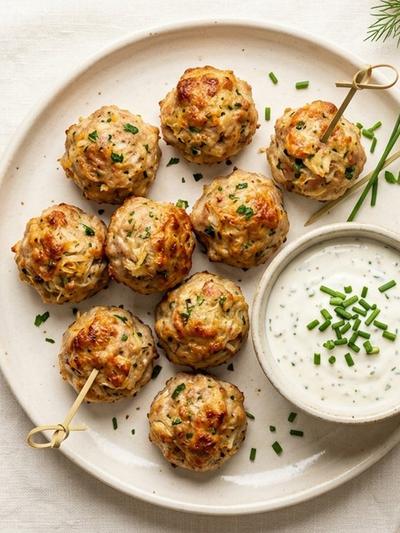
Each serving of these savory tuna cakes delivers 34 grams of complete protein and just 285 calories — a ratio that works hard for anyone managing appetite and preserving lean mass on GLP-1 medication. Cannellini beans provide gentle fiber alongside a creamy interior structure, while Dijon mustard, briny capers, and finely chopped olives bring the unmistakable sharpness of southern French cooking. A cold caper-lemon yogurt dip rounds out each portion with an extra boost of protein and a bright acidic finish that cuts through the richness of the tuna.
Think of these as a portable version of salade niçoise baked into firm, golden cakes. Chunk light tuna provides the base, mashed white beans hold everything together without relying on heavy breadcrumbs, and Niçoise olives add small pops of savory depth. The edges crisp in the oven while the center stays tender and moist — a contrast that keeps each bite interesting, even when eaten cold straight from the fridge the next day.
That grab-and-go quality is exactly what makes these cakes practical for GLP-1 users. You bake one batch of twelve on a quiet afternoon, let them cool, and pull out three whenever you need a satisfying snack between meals. They hold their shape in a lunch container, sit easy in the stomach, and provide enough protein to genuinely curb hunger rather than just bridge the gap until dinner.
Why This Works on GLP-1
Protein preservation is one of the biggest nutritional concerns during GLP-1-assisted weight loss. When medications like Wegovy or Zepbound reduce your total calorie intake, your body can break down muscle tissue alongside fat — especially if protein falls short throughout the day. These tuna cakes deliver 34 grams per snack-sized serving, primarily from tuna and cannellini beans, supplying the amino acids your muscles need to stay intact. Distributing protein across meals and snacks rather than loading it all into dinner gives your body a more consistent supply for muscle protein synthesis.
The fiber from cannellini beans sits at 4 grams per serving — moderate and deliberate. GLP-1 medications already slow gastric emptying, so very high-fiber snacks can trigger uncomfortable bloating or fullness that lingers for hours. The level here adds enough bulk to support healthy digestion without overwhelming a sensitive system. The beans also contribute resistant starch, which feeds beneficial gut bacteria and promotes the kind of steady blood sugar response that complements your medication.
Beyond macronutrients, these cakes provide omega-3 fatty acids from the tuna, supporting cardiovascular health — a factor worth paying attention to since many people on Mounjaro or similar medications are also working to improve metabolic health markers. The low fat content (6 grams per serving) keeps the cakes light on the stomach while olives, mustard, and capers deliver satisfying flavor without relying on added oil or butter.
Ingredients (serves 4)
For the tuna cakes (makes 12):
- 3 cans (5 oz / 142g each) chunk light tuna in water, well drained
- 1 can (15 oz / 425g) cannellini beans, drained, rinsed, and roughly mashed
- 3 large eggs, lightly beaten
- 1/3 cup (25g) panko breadcrumbs
- 2 tablespoons (30g) Dijon mustard
- 2 tablespoons Niçoise or Kalamata olives, finely chopped
- 2 tablespoons capers, drained and finely chopped
- 3 tablespoons fresh flat-leaf parsley, finely chopped
- 1 tablespoon fresh dill, finely chopped
- Zest of 1 lemon
- 1/4 teaspoon freshly ground black pepper
- Olive oil cooking spray
For the caper-lemon yogurt dip:
- 3/4 cup (180g) plain nonfat Greek yogurt
- 1 tablespoon capers, finely chopped
- 1 tablespoon fresh lemon juice
- 1 teaspoon lemon zest
- 1/4 teaspoon freshly ground black pepper
Instructions
Prepare the tuna cake mixture:
Preheat your oven to 375°F (190°C) and line a large baking sheet with parchment paper. Lightly mist the parchment with cooking spray to prevent the cakes from sticking without adding significant fat.
Place the drained cannellini beans in a large mixing bowl and mash roughly with a fork, leaving some small chunks intact. The partially mashed texture gives the cakes structure while keeping a pleasant, slightly rustic interior that doesn't crumble apart.
Add the drained tuna, breaking it into flakes with a fork. Fold in the beaten eggs, panko, Dijon mustard, chopped olives, capers, parsley, dill, lemon zest, and black pepper. Mix until everything is evenly distributed — the mixture should be moist but hold its shape when pressed together between your palms.
Shape and bake:
Scoop roughly 3 tablespoons of mixture per cake, forming 12 round patties about 2.5 inches (6 cm) in diameter and 3/4 inch (2 cm) thick. Arrange them on the prepared baking sheet with about 1 inch (2.5 cm) between each cake to allow for even browning.
Lightly mist the tops with cooking spray. This thin layer encourages a golden crust on the surface without soaking the cakes in oil.
Bake for 12 minutes, then carefully flip each cake with a thin spatula. Return to the oven for another 10–12 minutes until both sides are golden and the internal temperature reaches 160°F (71°C). The edges should feel firm and slightly crisp when pressed gently.
Let the cakes cool on the baking sheet for 5 minutes before transferring to a wire rack. They firm up considerably as they cool, which makes them easier to handle, stack, and store without falling apart.
Make the caper-lemon yogurt dip:
- While the cakes bake, stir together the Greek yogurt, chopped capers, lemon juice, lemon zest, and black pepper in a small bowl. Taste and adjust the lemon juice if you prefer a sharper dip. Divide into 4 small containers if you are prepping for the week, or refrigerate in a single sealed jar.
Nutrition per Serving
| Nutrient | Amount (approx.) |
|---|---|
| Calories | ~285 kcal |
| Protein | ~34g |
| Fat | ~6g |
| Carbohydrates | ~20g |
| Fiber | ~4g |
Estimates based on chunk light tuna in water (drained), canned cannellini beans, large eggs, panko breadcrumbs, and nonfat Greek yogurt. Exact values may vary by brand.
Practical Notes
Store and reheat with confidence. The baked cakes keep refrigerated in an airtight container for up to 5 days. Eat them cold straight from the fridge — they are genuinely good this way and require no reheating at all. If you prefer them warm, place them in a 350°F (175°C) oven for 5–7 minutes. Microwave reheating works in a pinch but softens the crisp exterior.
Freeze individual portions for longer storage. Flash-freeze the cooled cakes in a single layer on a parchment-lined tray until solid, then transfer to a zip-lock bag. They keep for up to 3 months. Thaw overnight in the fridge and warm briefly in the oven to restore texture. The yogurt dip does not freeze well — make it fresh each week, which takes about 2 minutes.
Adjust portions to your appetite window. If you are in the early weeks of GLP-1 treatment and your appetite is very low, eat two cakes instead of three for roughly 190 calories and 23 grams of protein. You can always eat the third cake later in the day when hunger returns, keeping your total protein intake on track without forcing volume.
Swap the fish to suit your taste or budget. Canned wild salmon works as a direct replacement and adds more omega-3 fatty acids, though the flavor will be slightly milder and the color darker. Canned sardines in water bring more intensity and even higher omega-3 content — remove any large spine bones before mixing. Avoid oil-packed tuna, which significantly raises the fat content per serving.
Pack them for work or travel. Stack three cakes in a small container with a separate pot of the yogurt dip alongside. They do not leak, they do not need to stay hot, and they hold safely at room temperature in a lunch bag for several hours — far more practical than most high-protein snack options that require refrigeration or reheating.
Frequently Asked Questions
Will these tuna cakes upset my stomach on GLP-1 medication?
Can I use a different type of bean instead of cannellini?
How should I store the cakes and dip for weekly meal prep?
What if my appetite is too small for three cakes right now?
Can I bake these in a muffin tin instead of on a sheet pan?
This article provides general food and nutrition guidance only. It does not constitute medical advice. Always consult your healthcare provider regarding your GLP-1 medication and individual nutritional needs.