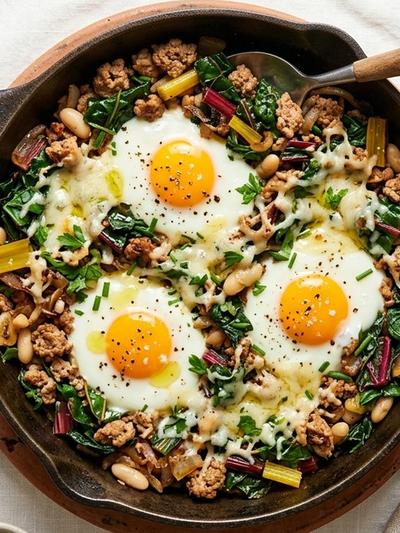
This skillet delivers 36 grams of protein per serving from a trio of lean sources — chicken breast, eggs, and white beans — while staying under 380 calories. The combination of complete animal proteins with plant-based fiber from cannellini beans makes this a nutrient-dense start to the day that supports muscle preservation during weight loss. Each serving also provides a solid dose of B vitamins from the mushrooms and iron from the spinach, two nutrients that often fall short when appetite is reduced.
The flavors here are unmistakably morning-appropriate: earthy cremini mushrooms, fresh thyme, and a whisper of Worcestershire sauce create a savory depth reminiscent of a traditional Full English, but without the grease. The chicken breast cooks quickly in small dice, staying tender against the meaty mushrooms, while soft-set eggs on top add richness without heaviness. A final scatter of fresh chives brightens everything and keeps the dish feeling light.
For GLP-1 users, this one-skillet format means minimal cleanup on mornings when energy is limited. The portions are designed to be satisfying without overwhelming a reduced appetite — the protein density ensures you feel genuinely nourished from a smaller plate. Everything cooks in a single skillet in under 25 minutes, making it practical even on weekday mornings.
Why This Works on GLP-1
Each serving provides 36 grams of protein, which is critical for preserving lean muscle mass during GLP-1-assisted weight loss. Research consistently shows that adequate protein intake — at least 25 to 30 grams per meal — helps prevent the muscle loss that can accompany rapid weight reduction on medications like Mounjaro or Wegovy. By combining chicken breast with eggs and white beans, this recipe delivers complete amino acid profiles from multiple sources, which supports better absorption and utilization throughout the morning.
The white beans contribute 5 grams of fiber per serving, enough to support digestive regularity without the bloating that higher-fiber foods can cause when gastric emptying is already slowed. Mushrooms add prebiotic compounds that nourish gut bacteria, and the spinach wilts down to an easily digestible volume while retaining its iron and folate content.
At just 378 calories, this is a calorie-efficient meal that prioritizes protein above all else. The moderate fat content — mostly from the olive oil and egg yolks — provides essential fatty acids and helps with fat-soluble vitamin absorption without making the dish feel heavy. This balance makes it particularly well-suited for mornings when Zepbound or similar medications have reduced your desire to eat large volumes.
Ingredients (serves 2)
For the skillet:
- 8 oz (225g) boneless, skinless chicken breast, cut into 1/2-inch (1cm) dice
- 6 oz (170g) cremini mushrooms, sliced
- 1/2 cup (85g) canned cannellini beans, drained and rinsed
- 1 cup (30g) baby spinach
- 1 small yellow onion, finely diced
- 2 cloves garlic, minced
- 1 tablespoon (15ml) olive oil
- 1 teaspoon Worcestershire sauce
- 1 teaspoon fresh thyme leaves (or 1/2 teaspoon dried)
- 1/4 teaspoon smoked paprika
- Salt and freshly ground black pepper to taste
For the eggs:
- 3 large eggs
- 1 tablespoon (15ml) water
- Pinch of salt
To finish:
- 1 tablespoon fresh chives, finely snipped
- Freshly ground black pepper
Instructions
Cook the chicken and vegetables:
Heat the olive oil in a 10-inch (25cm) nonstick or cast-iron skillet over medium-high heat until it shimmers. Add the diced chicken breast in a single layer and cook without stirring for 2 minutes, allowing a light golden sear to develop — this creates flavor depth without deep-frying. Stir once and cook for another 1 to 2 minutes until the chicken is just cooked through. Transfer to a plate and set aside.
Reduce the heat to medium. Add the diced onion to the same skillet and cook for 3 minutes, stirring occasionally, until softened and translucent. The onion will pick up any fond left by the chicken, which adds savory flavor without extra fat.
Add the sliced mushrooms and a pinch of salt. Cook for 4 to 5 minutes, stirring occasionally, until the mushrooms have released their moisture and turned golden. The salt draws out liquid faster, which helps the mushrooms brown rather than steam.
Stir in the garlic, thyme, and smoked paprika. Cook for 30 seconds until fragrant — watch the garlic carefully, as it burns quickly at this stage.
Build the skillet:
Add the cannellini beans to the skillet and stir to combine with the mushroom mixture. Cook for 1 minute to warm the beans through. Return the seared chicken to the skillet and toss everything together.
Add the Worcestershire sauce and stir to coat evenly. The Worcestershire adds umami complexity that echoes a traditional British breakfast without needing bacon or sausage.
Scatter the baby spinach over the top of the skillet. It will look like a lot, but it wilts down dramatically in about 1 minute. Gently fold the wilted spinach into the mixture.
Add the eggs:
Make 3 small wells in the skillet mixture using the back of a spoon. Crack one egg into each well. Add a tablespoon of water to the skillet, then cover with a lid or a sheet of aluminum foil.
Reduce the heat to medium-low and cook covered for 3 to 4 minutes. Check at 3 minutes — the whites should be fully set while the yolks remain soft and runny. For firmer yolks, cook an additional 1 to 2 minutes. The steam from the covered skillet cooks the tops of the eggs gently, avoiding the need for flipping.
Serve:
- Remove from heat. Season with freshly ground black pepper and scatter the snipped chives over the top. Serve directly from the skillet, dividing the eggs so one person gets two and the other gets one, or splitting all three evenly.
Nutrition per Serving
| Nutrient | Amount (approx.) |
|---|---|
| Calories | ~378 kcal |
| Protein | ~36g |
| Fat | ~16g |
| Carbohydrates | ~20g |
| Fiber | ~5g |
Estimates based on USDA data for raw boneless skinless chicken breast, large eggs, canned cannellini beans, and cremini mushrooms. Actual values may vary depending on specific brands and exact portion sizes.
Practical Notes
Make it meal prep. Cook the chicken-mushroom-bean base in a larger batch (double or triple the recipe) and store in airtight containers for up to 4 days. In the morning, reheat a portion in a skillet over medium heat and add fresh eggs — this cuts your active cooking time to under 5 minutes.
Divide portions according to appetite. If your GLP-1 medication has significantly reduced your appetite, serve yourself the smaller portion with one egg and save the rest for a second breakfast later in the day. The base reheats well in the microwave at 50% power for 90 seconds, though eggs are best cooked fresh.
Swap the chicken if needed. Ground chicken or turkey works equally well — just crumble it into the skillet in step 1 and break it apart with a wooden spoon as it cooks. Turkey sausage (removed from casings) creates a more traditional breakfast sausage flavor. For a vegetarian version, use 7 oz (200g) extra-firm tofu, crumbled and pressed.
Use any mushrooms you like. Cremini mushrooms are suggested for their reliable availability and meaty texture, but baby bellas, shiitake caps, or a mix of wild mushrooms all work beautifully. Avoid portobellos here — their dark spores can turn the entire skillet an unappealing grey color.
Add toast only if your appetite allows. A thin slice of whole grain sourdough alongside this skillet adds about 80 calories and 4 grams of fiber. Many GLP-1 users find the skillet alone is filling enough, so assess your hunger before adding sides. If you do add bread, use it to mop up the runny egg yolk — that is half the pleasure of this dish.
Frequently Asked Questions
I take my GLP-1 medication in the morning and have almost no appetite — can I still eat this?
Can I use egg whites instead of whole eggs to reduce fat?
How long does this keep in the fridge, and can I freeze it?
I am in my first few weeks on GLP-1 medication and everything feels too heavy — how should I adapt this?
Why do you cook the chicken separately before adding it back?
This article provides general food and nutrition guidance only. It does not constitute medical advice. Always consult your healthcare provider regarding your GLP-1 medication and individual nutritional needs.