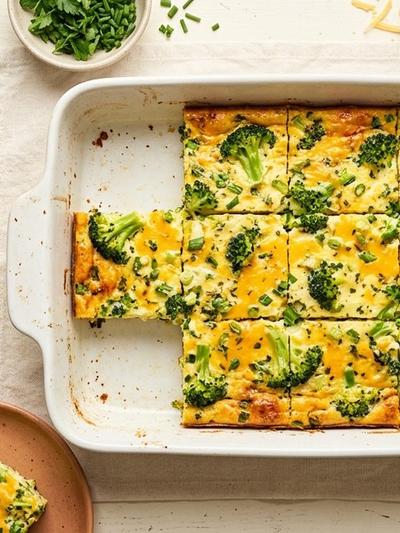
Each serving of these ranch-seasoned egg white squares delivers roughly 26 grams of protein from a combination of egg whites, cottage cheese, and sharp cheddar — all for under 200 calories. Egg whites supply leucine-rich, highly bioavailable protein while keeping fat and calories remarkably low, and the cottage cheese base adds casein protein that digests slowly and sustains satiety between meals. Red bell pepper contributes over 100% of your daily vitamin C, which supports collagen synthesis and iron absorption. These are nutritionally dense squares designed to do real work in a limited-appetite day.
The ranch seasoning blend — dried dill, chives, garlic powder, onion powder, and parsley — gives these squares a flavor that hits the same satisfying note as your favorite ranch dip without any of the heavy dairy fat. Bits of crispy turkey bacon scattered throughout add a subtle smokiness that keeps each bite interesting, while sweet red bell pepper and tender baby spinach prevent the texture from becoming monotonous. The result is a savory, herb-forward square with a firm but tender interior and just enough cheddar to melt into golden pockets throughout.
For people on GLP-1 medications, the appeal here is practical: you bake one pan, cut twelve squares, and have a week of portioned snacks ready in the refrigerator. There is no measuring or assembly required at snack time. The squares are gentle on digestion — no heavy oils, no fried coating, no raw vegetables that might cause discomfort when gastric emptying is slowed — and they eat well cold or quickly reheated.
Why This Works on GLP-1
Each three-square serving provides approximately 26 grams of protein, primarily from egg whites and low-fat cottage cheese. This matters because muscle preservation is one of the most important nutritional goals during GLP-1-assisted weight loss. Research consistently shows that people taking Mounjaro lose both fat and lean mass, and adequate protein intake — particularly spaced across meals and snacks — helps minimize that muscle loss. The leucine content in egg whites is especially relevant here, since leucine is the amino acid most directly responsible for triggering muscle protein synthesis.
The fat content is deliberately low at around 6 grams per serving, which makes these squares easier to digest when your stomach is emptying more slowly. Heavy, high-fat snacks are the most common trigger for nausea on GLP-1 medications, so keeping the fat modest while still including enough cheddar for flavor and satisfaction is a balance worth getting right. The red bell pepper adds a gentle dose of fiber and a solid hit of antioxidants without the bulk or gas risk that comes with cruciferous vegetables or large bean portions.
Because appetite windows on Wegovy and similar medications can be narrow and unpredictable, having pre-portioned protein snacks in the refrigerator eliminates the risk of skipping protein entirely when you do not feel like cooking. Three squares take about ninety seconds to eat, require no utensils, and provide meaningful nutrition that keeps your daily protein total on track even when full meals feel like too much.
Ingredients (serves 4)
For the ranch seasoning:
- 1 teaspoon dried dill
- 1 teaspoon dried chives
- ½ teaspoon garlic powder
- ½ teaspoon onion powder
- ¼ teaspoon dried parsley
- ¼ teaspoon black pepper
- ¼ teaspoon fine sea salt
For the squares:
- 14 large egg whites (or 1¾ cups / 420ml liquid egg whites from a carton)
- 1 cup (226g) low-fat (2%) cottage cheese
- ½ cup (56g) shredded reduced-fat sharp cheddar cheese
- 4 slices turkey bacon
- 1 medium red bell pepper, finely diced (about ¾ cup / 120g)
- 2 cups (60g) baby spinach, roughly chopped
- 2 scallions, thinly sliced
- Nonstick cooking spray
Instructions
Cook the turkey bacon:
- Place 4 slices of turkey bacon in a cold skillet, then set it over medium heat. Cook for 5 to 6 minutes, flipping once, until the edges are crisp and the slices have rendered most of their fat. Transfer to a paper towel-lined plate and let cool for a couple of minutes before chopping into small pieces. Starting in a cold pan prevents turkey bacon from curling and ensures even crisping.
Make the egg white base:
Preheat your oven to 350°F (175°C). Lightly coat a 9x13-inch (23x33 cm) baking dish with cooking spray.
Stir together all the ranch seasoning ingredients in a small bowl and set aside. Mixing the spices first ensures even distribution throughout the egg base rather than clumps of garlic powder in one corner.
In a large bowl, whisk the egg whites and cottage cheese together vigorously for about 30 seconds. You want the cottage cheese curds mostly broken down but not completely smooth — a few small curds add pleasant texture to the finished squares. Add the ranch seasoning blend and whisk again until evenly incorporated.
Assemble and bake:
Fold the diced red bell pepper, chopped spinach, sliced scallions, turkey bacon pieces, and shredded cheddar into the egg white mixture. The vegetables will seem like a lot of volume, but they cook down considerably.
Pour the mixture into the prepared baking dish and use a spatula to spread it into an even layer. Gently tap the dish on the counter once or twice to release any large air bubbles.
Bake on the center rack for 22 to 25 minutes. The squares are done when the center is fully set with no visible jiggle, the surface is matte rather than glossy, and the edges show the faintest golden color. A toothpick inserted into the center should come out clean.
Let the pan cool on a wire rack for at least 10 minutes — this resting time firms the squares and makes clean cuts possible. Slice into a 4x3 grid to yield 12 squares.
Nutrition per Serving
| Nutrient | Amount (approx.) |
|---|---|
| Calories | ~195 kcal |
| Protein | ~26g |
| Fat | ~6g |
| Carbohydrates | ~6g |
| Fiber | ~1g |
Calculated using USDA values for large egg whites, 2% cottage cheese, reduced-fat sharp cheddar, and standard turkey bacon. Actual values may vary by brand.
Practical Notes
Refrigerator storage keeps them for the full work week. Store cooled squares in a single layer in an airtight container, or stack with small pieces of parchment paper between layers to prevent them from sticking together. They hold their texture and flavor well for up to 5 days at 40°F (4°C), which means a Sunday bake covers you through Friday.
Eat them cold or reheat — both work. These squares eat well straight from the refrigerator, which makes them a true grab-and-go snack. If you prefer them warm, microwave for 30 to 45 seconds or pop them in a toaster oven at 350°F (175°C) for 3 to 4 minutes to restore a bit of edge crispness.
Carton egg whites save serious time. Separating 14 eggs is fiddly and leaves you with a pile of yolks to deal with. Use 1¾ cups (420ml) of pasteurized liquid egg whites from a carton instead — they perform identically in this recipe and are already measured by volume on the container.
Freeze individual squares for longer storage. Wrap each square tightly in plastic wrap, place them in a freezer-safe bag, and freeze for up to 2 months. Thaw overnight in the refrigerator, or microwave directly from frozen for 60 to 90 seconds. The texture softens slightly after freezing but remains perfectly good as a snack.
Add fiber with a simple swap. For more fiber per serving, fold in ½ cup (85g) of rinsed, drained canned white beans or swap the spinach for finely chopped kale. Either change adds roughly 2 to 3 grams of fiber per serving without meaningfully altering the protein content or calorie count.
Frequently Asked Questions
I get nauseous from eggs on my GLP-1 medication — will egg whites bother me too?
Can I use whole eggs instead of egg whites?
How should I reheat these at work without a toaster oven?
I can barely eat anything in the morning — is one square enough as a snack?
My squares came out rubbery — what went wrong?
This article provides general food and nutrition guidance only. It does not constitute medical advice. Always consult your healthcare provider regarding your GLP-1 medication and individual nutritional needs.