 By Gerald
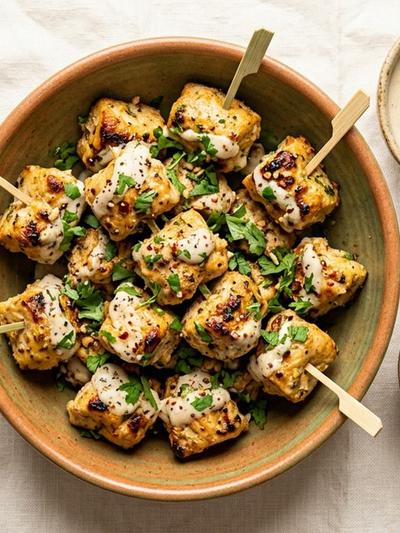
Each serving of these achiote chicken bites packs 30 grams of protein into just 180 calories — an exceptional ratio for a snack you can eat with one hand. Achiote paste, the earthy, slightly peppery Yucatecan spice blend built around annatto seed, coats cubed chicken breast in a vibrant red-orange marinade that crisps beautifully in the air fryer. A cool tomatillo-pepita yogurt dip rounds out each bite with tangy brightness and a subtle nuttiness from toasted pumpkin seeds. You get all of this in about 22 minutes, start to finish.
The Yucatecan character comes from achiote paste dissolved in fresh orange and lime juice — a combination that tenderizes the chicken while building layers of citrus, oregano, and mild warmth. The air fryer does what it does best: renders the exterior slightly caramelized and snappy without any added oil, while the interior stays juicy from the citrus marinade. The dip pulls in a different direction — raw tomatillos blended with Greek yogurt bring a bright acidity that cuts the earthy spice, and toasted pepitas add a gentle crunch and nutty depth that echoes traditional pipián.
For GLP-1 users, snacks need to earn their place: small enough to eat comfortably with a reduced appetite, but protein-dense enough to prevent the muscle loss that can accompany rapid weight change. These bites check both boxes. At just 180 calories, a four-bite serving delivers the protein equivalent of a full chicken breast without the heaviness, and the tangy dip makes even two or three bites feel like a complete eating experience.
Why This Works on GLP-1
Thirty grams of protein per serving puts these bites in the top tier of snack-category recipes for muscle preservation during GLP-1-assisted weight loss. Research consistently shows that protein intake above 25 grams per meal or snack triggers meaningful muscle protein synthesis — the process that maintains lean mass as total body weight drops. Whether you are on Ozempic, Wegovy, Mounjaro, or Zepbound, the reduced appetite these medications produce makes it critical that every bite you do eat carries its weight nutritionally. These bites deliver that without asking your stomach to handle a large volume of food.
The tomatillo-yogurt dip adds a probiotic element from the Greek yogurt, which supports the gut microbiome — something GLP-1 users sometimes find disrupted by changes in eating patterns. The recipe avoids common digestive irritants: there is no heavy fat load, no deep frying, and the jalapeño in the dip is optional and seeded for gentleness. Achiote itself is well tolerated by most people and adds real flavor complexity without significant heat.
At only 4 grams of fat per serving, these bites sidestep the sluggish digestion that high-fat snacks can cause when gastric emptying is already slowed by GLP-1 medication. The citrus marinade also provides a modest dose of vitamin C, which supports iron absorption from the chicken — relevant when your overall food intake is lower than it used to be.
Ingredients (serves )
For the achiote chicken bites:
- 1 lb (450g) boneless, skinless chicken breast, cut into 1-inch (2.5 cm) cubes
- 1½ tablespoons achiote paste (about ¾ oz / 20g)
- 1 tablespoon fresh orange juice
- 1 tablespoon fresh lime juice
- ½ teaspoon ground cumin
- ½ teaspoon dried Mexican oregano
- 1 clove garlic, finely minced
- ¼ teaspoon salt
- Cooking spray
For the pepita-tomatillo dip:
- 4 medium tomatillos (about 7 oz / 200g), husked and rinsed
- ½ cup (130g) plain nonfat Greek yogurt
- 2 tablespoons (18g) toasted pepitas (hulled pumpkin seeds)
- ¼ cup loosely packed fresh cilantro
- 1 small jalapeño, seeded (optional)
- 1 tablespoon fresh lime juice
- ¼ teaspoon salt
Instructions
Amounts in the method are for 4 servings.
Prepare the marinade and chicken:
In a medium bowl, dissolve the achiote paste in the orange juice and lime juice, mashing with a fork until smooth — this takes about a minute. The paste is dense and needs the acid to break down evenly. Add the cumin, oregano, garlic, and salt. Stir to combine into a thick, rust-colored slurry.
Add the chicken cubes and toss until every piece is evenly coated in the marinade. Let sit for at least 10 minutes at room temperature while you prepare the dip, which gives the acid time to begin tenderizing the surface. For deeper flavor, you can marinate in the refrigerator for up to 8 hours.
Make the pepita-tomatillo dip:
- Quarter the tomatillos and add them to a blender or small food processor along with the Greek yogurt, pepitas, cilantro, jalapeño (if using), lime juice, and salt. Blend until smooth, about 30 seconds. The dip should be pourable but thick enough to cling to a chicken bite when you drag one through it. Refrigerate until serving.
Air fry the chicken bites:
Preheat your air fryer to 380°F (193°C) for 3 minutes.
Lightly mist the marinated chicken cubes with cooking spray. Arrange them in a single layer in the air fryer basket, leaving a small gap between each piece so hot air circulates freely — this is what creates the crisp exterior rather than a steamed texture. Work in two batches if your basket is smaller than 5 quarts.
Air fry for 10–12 minutes, shaking the basket or flipping the cubes at the 6-minute mark. The bites are done when the edges are lightly charred and the internal temperature reaches 165°F (74°C). The achiote marinade darkens as it caramelizes, so judge doneness by temperature rather than color alone.
Transfer to a plate and let rest for 2 minutes — the residual heat finishes cooking the center without drying it out. Serve warm alongside the chilled dip, with the remaining pepitas scattered over the dip for garnish.
Nutrition per Serving
| Nutrient | Amount (approx.) |
|---|---|
| Calories | ~180 kcal |
| Protein | ~30g |
| Fat | ~4g |
| Carbohydrates | ~5g |
| Fiber | ~1g |
Calculated from USDA data for raw boneless skinless chicken breast, commercial achiote paste, raw tomatillos, nonfat Greek yogurt, and hulled pumpkin seeds. Actual values may vary with specific brands of achiote paste.
Practical Notes
Store the bites and dip separately. The chicken stays crisp-edged for up to 4 days in an airtight container in the refrigerator. The dip keeps for 3 days. To reheat, air fry the bites at 350°F (177°C) for 3–4 minutes — the microwave works but softens the exterior into something closer to poached chicken.
Achiote paste is worth tracking down. Look in the Latin foods aisle of most supermarkets — El Yucateco and Goya are the most common brands — or any Latin grocery store. It is inexpensive, shelf-stable for months after opening (refrigerated), and has no real substitute. The combination of annatto seed, oregano, cumin, and vinegar is distinctive. Do not confuse it with achiote powder, which is pure annatto and provides color but very little of the complexity.
Start with two or three bites if your appetite is very small. One of the advantages of a bite-sized snack is that you can eat exactly as much as your body wants without wasting a prepared portion. Two bites still deliver about 15 grams of protein, which is meaningful. Refrigerate the rest and come back to them later in the day.
Pair with jicama or cucumber sticks for added fiber. The bites themselves are intentionally lean and low-fiber to keep digestion easy. If your body tolerates fiber well, slicing raw jicama into matchsticks gives you a crunchy, mildly sweet vehicle that picks up the dip beautifully and adds about 3 grams of fiber per half-cup serving.
Double the batch for weekly snack prep. This recipe scales perfectly. Marinate 2 pounds of chicken, air fry in three or four batches, and divide into individual containers with small dip portions alongside. The total active time only increases by about 10 minutes because the prep work stays the same.
Frequently Asked Questions
Can I eat these bites if I'm in the early weeks of GLP-1 medication?
What can I use instead of achiote paste?
How long do these keep and can I freeze them?
How can I adapt this if my appetite is very small on GLP-1 medication?
My air fryer runs hot — how do I prevent the achiote from burning?
This article provides general food and nutrition guidance only. It does not constitute medical advice. Always consult your healthcare provider regarding your GLP-1 medication and individual nutritional needs.