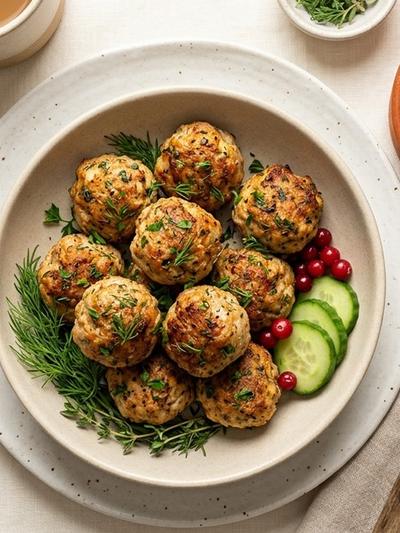
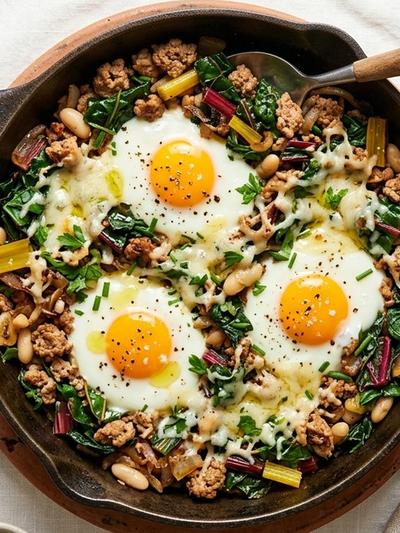
Each serving of these Mediterranean egg nests packs 34 grams of protein from two complementary sources — lean ground turkey and whole eggs — while staying under 350 calories. The turkey provides iron, zinc, and B vitamins critical for maintaining energy levels during weight loss, while eggs contribute choline and vitamin D. Roasted red peppers add vitamin C that improves iron absorption from the turkey, and a scattering of sun-dried tomatoes brings concentrated lycopene without excess bulk.
The concept is simple and deeply satisfying: seasoned ground turkey gets pressed into silicone muffin cups to form small, bowl-shaped nests, then a whole egg is cracked into each one and air fried until the turkey turns golden and the egg whites set around a just-runny yolk. Dried oregano, ground cumin, and a touch of smoked paprika give the turkey a warm, unmistakably Mediterranean backbone, while crumbled feta melts into the egg during the last minutes of cooking. The herb yogurt — bright with lemon, dill, and parsley — cuts through the richness and ties every bite to the eastern Mediterranean table.
For GLP-1 users, these nests solve two common breakfast problems at once. They are compact enough to eat comfortably when appetite is limited (two nests is a small, satisfying portion), yet protein-dense enough to protect lean muscle mass through the morning. The air fryer keeps hands-on time to about fifteen minutes and requires no added cooking oil beyond a light spray, keeping fat well below a traditional egg-and-sausage breakfast.
Why This Works on GLP-1
Preserving muscle mass is one of the most important nutritional goals while taking medications like Ozempic or Mounjaro, and research consistently shows that distributing protein across meals — rather than loading it at dinner — produces better results. These egg nests deliver 34 grams at breakfast, split between the slow-digesting casein and whey in the eggs and the complete amino acid profile of ground turkey. That combination keeps you in a positive muscle-protein-synthesis window through the morning without requiring a large volume of food.
The fat content sits at roughly 20 grams per serving, most of it from egg yolks and a small amount of feta. Because the air fryer circulates hot air around the nests rather than submerging them in oil, the turkey renders some of its own fat outward and crisps rather than steams. You get textural satisfaction — a golden, lightly crispy shell — without the heaviness that fried foods bring to a GLP-1-slowed stomach.
The roasted red peppers and baby spinach folded into the turkey mixture contribute potassium and folate, two micronutrients that can run low during periods of reduced food intake. Sun-dried tomatoes concentrate flavor in a very small volume, which matters when every bite needs to justify its place on a smaller plate. The herb yogurt adds probiotics that support a healthy gut lining, something worth paying attention to when gastric motility is already altered by medication.
Ingredients (serves 4)
For the turkey nests:
- 12 oz (340g) lean ground turkey (93% lean)
- 1/3 cup (50g) jarred roasted red peppers, drained and finely diced
- 2 tbsp (15g) sun-dried tomatoes (dry-packed), rehydrated in warm water for 5 minutes, finely chopped
- 1 cup (30g) baby spinach, finely chopped
- 1 clove garlic, minced
- 1 tsp dried oregano
- 1/2 tsp ground cumin
- 1/4 tsp smoked paprika
- 1/4 tsp fine sea salt
- 1/4 tsp black pepper
- Olive oil cooking spray
For the egg filling:
- 8 large eggs
- 2 oz (56g) crumbled feta cheese
- 1 tbsp fresh flat-leaf parsley, chopped (for garnish)
For the herb yogurt:
- 1/2 cup (120g) plain nonfat Greek yogurt
- 1 tbsp fresh lemon juice
- 1 tbsp fresh dill, finely chopped
- 1 tbsp fresh flat-leaf parsley, finely chopped
- Pinch of fine sea salt
Instructions
Prepare the turkey mixture:
In a medium bowl, combine the ground turkey, diced roasted red peppers, chopped sun-dried tomatoes, baby spinach, garlic, oregano, cumin, smoked paprika, salt, and pepper. Mix with your hands or a fork until the vegetables and spices are evenly distributed — avoid overworking the meat, which makes the nests tough rather than tender.
Divide the mixture into 8 equal portions, roughly 1.5 oz (42g) each. A kitchen scale helps here, but eyeballing is fine as long as portions are roughly even.
Form and fill the nests:
Lightly spray 8 silicone muffin cups with olive oil cooking spray. Press each turkey portion into a cup, pushing it up the sides to form a bowl shape with a well in the center deep enough to hold an egg. The walls should be about 1/4 inch (6mm) thick — thin enough to crisp but sturdy enough to hold together. If you don't have silicone cups, use small oven-safe ramekins (about 3 inches / 7.5 cm wide).
Crack one egg into each turkey nest. The egg should sit snugly inside the meat walls. If a little white spills over the edge, that is perfectly normal and will crisp up nicely.
Sprinkle the crumbled feta evenly over the tops of all 8 nests. The feta will soften and partially melt into the egg as it cooks, creating pockets of salty, tangy richness.
Air fry the nests:
Preheat your air fryer to 350°F (175°C) for 2 minutes. Place the filled cups in the air fryer basket in a single layer — you will likely need to cook in two batches of 4 depending on your air fryer size.
Air fry for 12 to 14 minutes. At 12 minutes the egg whites should be fully set but the yolks still slightly soft in the center. If you prefer fully set yolks, cook for the full 14 minutes. The turkey shell will be golden brown around the edges.
Let the nests rest in their cups for 2 minutes before removing — this allows the egg to finish setting and makes them easier to lift out without breaking.
Make the herb yogurt:
- While the nests cook, stir together the Greek yogurt, lemon juice, dill, parsley, and salt in a small bowl. Taste and adjust the lemon or salt to your preference. The yogurt should be bright and herbaceous, not bland.
Serve:
- Place 2 egg nests on each plate. Spoon a generous tablespoon of herb yogurt alongside or over the top. Finish with a scattering of fresh parsley. Serve immediately while the turkey shell is still crisp.
Nutrition per Serving
| Nutrient | Amount (approx.) |
|---|---|
| Calories | ~345 kcal |
| Protein | ~34g |
| Fat | ~20g |
| Carbohydrates | ~6g |
| Fiber | ~2g |
Estimates based on 93% lean ground turkey, large eggs, dry-packed sun-dried tomatoes, and nonfat Greek yogurt. Actual values vary by specific brands and egg size.
Practical Notes
Make ahead and reheat with care. Cooked nests keep in an airtight container in the refrigerator for up to 3 days. Reheat in the air fryer at 300°F (150°C) for 4 to 5 minutes — the microwave works in a pinch but softens the crispy turkey shell. For meal prep, form the raw turkey nests the night before, cover, and refrigerate; crack the eggs in fresh the next morning for the best texture.
Silicone cups matter. Standard metal muffin tins make it nearly impossible to remove the nests intact. Silicone muffin cups flex, letting you pop each nest out cleanly. They are inexpensive, reusable, and fit most air fryer baskets. If you only have ramekins, line them with a small parchment circle on the bottom.
Control the yolk doneness. At 350°F (175°C), 12 minutes gives a jammy yolk that runs when cut — ideal for dipping the turkey shell edges into. At 14 minutes the yolk is fully set, which is better for meal prep and on-the-go eating. Check your first batch and adjust; every air fryer runs slightly differently.
Scale for smaller appetites. During the early weeks of GLP-1 treatment, one nest plus a tablespoon of yogurt may be all you can manage — and that still delivers roughly 17 grams of protein. Wrap the second nest and refrigerate it for a mid-morning snack when hunger returns.
Swap the feta for variety. Goat cheese crumbles, shaved Parmesan, or a spoonful of ricotta all work in place of feta. Each changes the flavor profile slightly — goat cheese leans tangier, Parmesan adds nuttiness — but the protein and calorie impact stays comparable. Avoid soft melting cheeses like mozzarella, which can pool and make the bottom of the nest soggy.
Frequently Asked Questions
Can I use ground turkey breast (99% lean) instead of 93% lean?
What if I cannot find dry-packed sun-dried tomatoes?
How should I store and reheat leftover nests for meal prep?
I am in my first month on Wegovy and can barely eat — is this recipe still worth making?
Can I make these in the oven instead of an air fryer?
This article provides general food and nutrition guidance only. It does not constitute medical advice. Always consult your healthcare provider regarding your GLP-1 medication and individual nutritional needs.