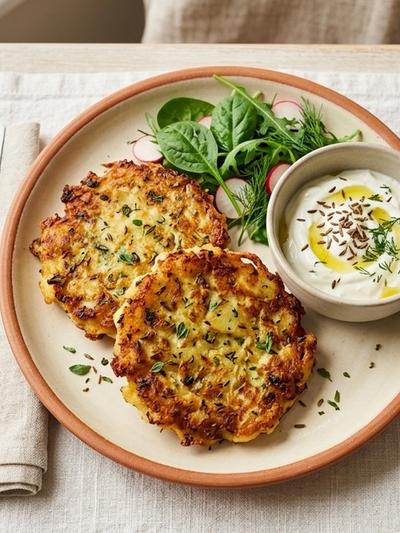
These French-inspired egg and zucchini galettes pack 27 grams of protein per serving while staying under 310 calories, making them a nutritionally dense lunch option. The combination of whole eggs, egg whites, and part-skim ricotta creates a complete amino acid profile with substantial leucine content for muscle maintenance. Each galette provides a satisfying ratio of protein to volume that keeps you fueled through the afternoon without overwhelming a reduced appetite.
The air fryer transforms these simple galettes into something special — crispy and golden on the outside with a tender, custard-like interior studded with shredded zucchini and fresh herbs. Fines herbes (the classic French blend of parsley, chives, tarragon, and chervil) give each bite a delicate, aromatic quality that pairs beautifully with the mild sweetness of the zucchini. A touch of Parmesan in the batter adds umami depth, while the herbed ricotta dollop on top brings creamy contrast to the crisp edges.
For GLP-1 users, these galettes hit a practical sweet spot: they are substantial enough to feel like a real lunch but light enough to sit comfortably during the slower gastric emptying that comes with medication. The air fryer means minimal added fat compared to pan-frying traditional galettes, and the entire recipe comes together in about 25 minutes. They also travel well in a lunch container, making them a reliable weekday option.
Why This Works on GLP-1
Each serving delivers approximately 27 grams of protein from eggs, egg whites, and ricotta — a meaningful amount for preserving lean muscle mass during GLP-1-assisted weight loss. Research consistently shows that protein intake of 25 grams or more per meal helps stimulate muscle protein synthesis, which is especially important for people on medications like Wegovy or Mounjaro where rapid weight loss can include muscle tissue if protein intake is insufficient. The egg-based protein here is among the most bioavailable sources, with a biological value of 100, meaning your body can efficiently use nearly all of it.
Zucchini contributes gentle, soluble fiber and high water content, which supports digestion without the bloating that higher-fiber vegetables can cause when gastric motility is already slowed by GLP-1 agonists. The galettes are also naturally low in residue, meaning they move through the digestive system smoothly — an important consideration when nausea or fullness are common side effects.
At just 305 calories per serving with 18 grams of fat, these galettes maintain a favorable protein-to-calorie ratio that supports body composition goals. The fat comes primarily from whole eggs and ricotta, providing fat-soluble vitamin absorption (vitamins A, D, E, and K) alongside the protein. This balanced macronutrient profile helps maintain steady blood sugar levels, complementing the glucose-regulating effects of GLP-1 medications.
Ingredients (serves 4)
For the galettes:
- 6 large eggs
- 4 large egg whites
- 2 medium zucchini (about 14 oz / 400g total)
- 1/4 cup (30g) oat flour (or finely ground rolled oats)
- 1 oz (28g) finely grated Parmesan
- 1 tablespoon fresh chives, finely chopped
- 1 tablespoon fresh flat-leaf parsley, finely chopped
- 1 teaspoon fresh tarragon, finely chopped (or 1/4 teaspoon dried)
- 1/2 teaspoon fine sea salt
- 1/4 teaspoon freshly ground black pepper
- 1/4 teaspoon freshly grated nutmeg
- Olive oil spray
For the herbed ricotta:
- 1 cup (250g) part-skim ricotta
- 1 tablespoon fresh chives, finely chopped
- 1 tablespoon fresh parsley, finely chopped
- 1 teaspoon lemon zest
- 1 tablespoon fresh lemon juice
- 1/4 teaspoon fine sea salt
- Pinch of black pepper
Instructions
Prepare the zucchini:
Grate the zucchini on the large holes of a box grater. Place the shredded zucchini in a clean kitchen towel or cheesecloth and squeeze firmly over the sink to remove as much moisture as possible. This step is essential — excess water will make the galettes soggy rather than crisp. You should extract at least 3–4 tablespoons of liquid.
Transfer the squeezed zucchini to a large mixing bowl and fluff it with a fork to break up any clumps.
Mix the batter:
In a separate bowl, whisk together the whole eggs and egg whites until uniformly combined. Pour the egg mixture over the zucchini.
Add the oat flour, grated Parmesan, chives, parsley, tarragon, salt, pepper, and nutmeg. Stir until everything is evenly distributed. The batter will be loose and pourable — this is correct. Let it rest for 5 minutes while you prepare the ricotta, allowing the oat flour to hydrate slightly and help bind the galettes.
Make the herbed ricotta:
- In a small bowl, combine the ricotta, chives, parsley, lemon zest, lemon juice, salt, and pepper. Stir until smooth and set aside. This can be made up to 2 days ahead and refrigerated.
Air fry the galettes:
Preheat the air fryer to 375°F (190°C) for 3 minutes. Lightly spray the air fryer basket or silicone molds with olive oil spray.
If using silicone muffin molds (recommended for easier handling), place them in the air fryer basket and pour approximately 1/3 cup of batter into each mold. If working without molds, pour the batter directly into a lightly sprayed round air fryer–safe pan or parchment-lined basket in a thin, even layer about 1/2 inch (1 cm) thick.
Air fry at 375°F (190°C) for 10–12 minutes, until the galettes are set in the center and golden brown on the edges. The tops should feel firm when gently pressed. If your air fryer runs hot, check at 9 minutes.
Let the galettes cool in the basket for 2 minutes before carefully removing. They will firm up slightly as they cool.
Serve:
- Plate 2 galettes per serving and top each with a generous dollop (about 2 tablespoons) of herbed ricotta. Serve warm or at room temperature with a simple green salad or sliced tomatoes on the side.
Nutrition per Serving
| Nutrient | Amount (approx.) |
|---|---|
| Calories | ~305 kcal |
| Protein | ~27g |
| Fat | ~18g |
| Carbohydrates | ~9g |
| Fiber | ~2g |
Estimates based on 6 large eggs, 4 egg whites, 1 cup part-skim ricotta, 1 oz Parmesan, 2 medium zucchini, and 1/4 cup oat flour divided into 4 servings.
Practical Notes
Meal prep and storage. These galettes refrigerate well for up to 4 days in an airtight container. Reheat in the air fryer at 350°F (175°C) for 3–4 minutes to restore crispness — microwaving works but sacrifices the texture. Store the herbed ricotta separately to keep everything fresh.
Squeezing the zucchini matters. This is the single most important step in the recipe. Watery zucchini creates steam inside the galettes, resulting in a soft, pale result instead of the golden, crispy exterior you want. A clean kitchen towel works better than paper towels for this job — wring it firmly until barely any liquid drips out.
Silicone molds make portioning easy. Individual silicone muffin cups or egg bite molds designed for air fryers produce the most uniform galettes and make them simple to remove. If you don't have molds, a 6-inch (15cm) round silicone or metal pan works well — just slice the large galette into portions after cooking.
For smaller GLP-1 appetites, start with one galette. If you are in the early weeks of your medication or experiencing stronger appetite suppression, a single galette with a tablespoon of herbed ricotta still provides roughly 13–14 grams of protein. Pair it with a few cherry tomatoes or cucumber slices for a complete light lunch that won't overwhelm your stomach.
Herb substitutions. If you cannot find tarragon or chervil for a traditional fines herbes blend, use all chives and parsley with a small pinch of dried thyme. Fresh dill also works beautifully here and leans the flavor profile toward a Scandinavian direction. Avoid dried herb blends for the ricotta topping — fresh herbs make a noticeable difference in both flavor and appearance.
Frequently Asked Questions
Can I eat these galettes if I'm experiencing GLP-1 side effects like nausea?
Can I make these without dairy or substitute the ricotta?
How long do these keep, and can I freeze them?
I'm in the first few weeks of Zepbound and can only eat very small portions. How should I adapt this?
Can I cook these in a regular oven instead of an air fryer?
This article provides general food and nutrition guidance only. It does not constitute medical advice. Always consult your healthcare provider regarding your GLP-1 medication and individual nutritional needs.